If you are shopping for a sub-four-metre crossover on a tight budget, crash protection is no longer an afterthought. Buyers want sheet metal that holds up.
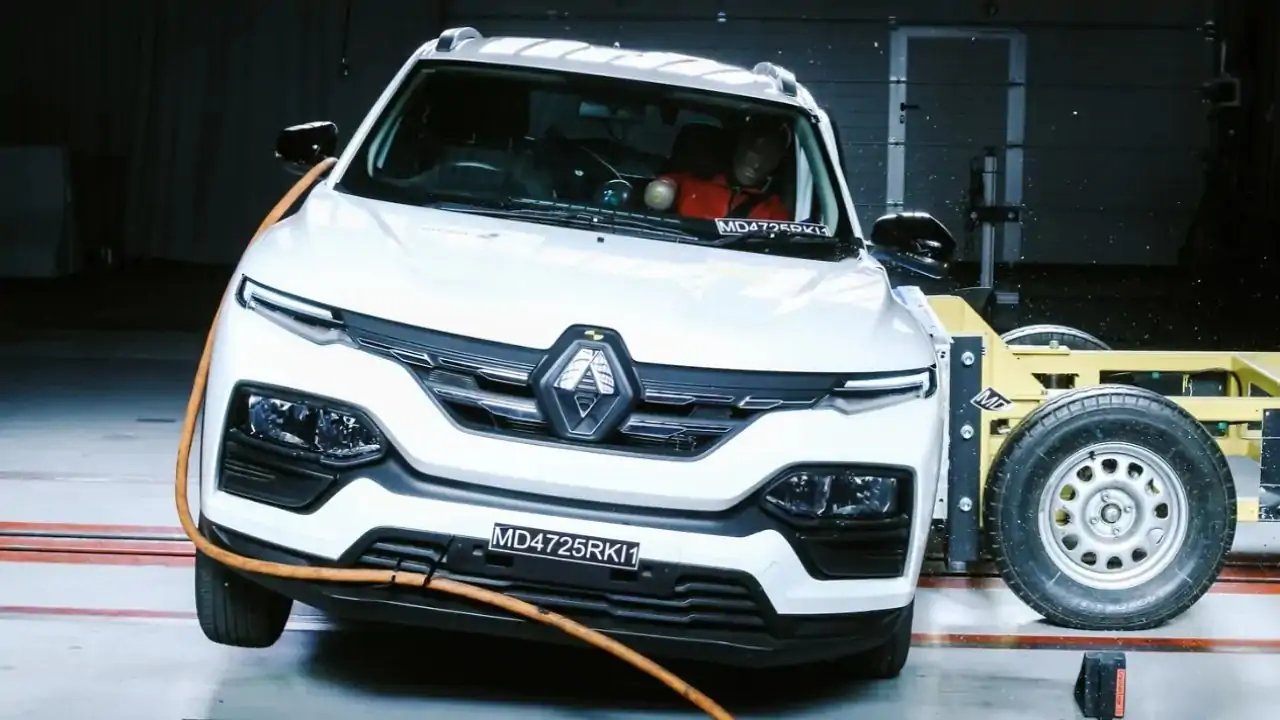
The Made-in-India Renault Kiger has secured a four-star adult occupant protection score in the latest round of Global NCAP crash tests. Assessed under the watchdog's updated protocols as part of the Safer Cars for Africa programme, the compact SUV bagged 25.20 points out of a maximum 34 for adult safety. It paired that with a three-star child protection tally of 30.21 points out of 49. The vehicle supplied for testing carried six airbags, Electronic Stability Control (ESC), and ISOFIX child-seat mounts as standard equipment.
Yet the crash laboratory tells a divided story.
Global NCAP testers flagged critical structural boundaries when running the Kiger into the offset barrier. Both the bodyshell and the footwell area were rated unstable under frontal offset loading. The structure could not absorb further stress beyond the test baseline.
Side impact protection presented another complication. While the Kiger delivered acceptable containment across specific impact zones, an unlatched door opened during the side crash test. That structural release triggered an immediate scoring deduction.
Child occupant assessments revealed sharp disparities between age brackets. Global NCAP technicians mounted two child dummies in the rear cabin: an 18-month-old infant and a three-year-old toddler.
The 18-month-old dummy received complete protection in both frontal and side impacts. The three-year-old fared poorly. In the frontal offset crash, the larger child dummy experienced forward excursion, allowing its head to strike interior vehicle surfaces. During the side barrier strike, the child restraint setup failed to isolate lateral movement, resulting in zero points awarded for head protection.
| Assessment Parameter | Score Achieved | Maximum Possible | Star Rating |
|---|---|---|---|
| Adult Occupant Protection | 25.20 | 34.00 | 4 Stars |
| Child Occupant Protection | 30.21 | 49.00 | 3 Stars |
| Bodyshell Integrity | Unstable | — | — |
| Footwell Integrity | Unstable | — |
Market Context: Automakers including Renault have historically raised objections against Global NCAP testing parameters, arguing that overseas protocols bypass domestic regulatory criteria while evaluating emerging-market inventory. Even so, the latest scores mark an upward shift over previous baseline runs.
For buyers walking onto dealership floors, the mechanical package remains unchanged. The India-spec Renault Kiger operates exclusively with two 1.0-litre, three-cylinder petrol engines.
The entry naturally aspirated 1.0-litre unit produces 71hp and 96Nm of peak torque. Power runs through either a 5-speed manual or a 5-speed automated manual transmission (AMT). Dealerships also offer an approved aftermarket CNG retrofit kit for fleet operators and cost-conscious urban commuters looking to slash running expenses.
Drivers wanting highway punch step up to the 1.0-litre turbo-petrol. That engine develops 99hp and up to 160Nm of torque depending on transmission pairing, linked either to a 5-speed manual gearbox or an X-Tronic CVT automatic.
Pricing holds firm. The Kiger portfolio starts at ₹5.81 lakh for the entry-level Authentic MT and stretches up to ₹10.40 lakh (ex-showroom India) for the flagship Emotion CVT Turbo variant.
With factory-fitted electronic stability control and side airbags now establishing themselves on entry crossover brochures, the Kiger enters its next sales cycle armed with verified safety metrics. Showroom deliveries of current-specification models continue nationwide across authorized retail networks.
| — |