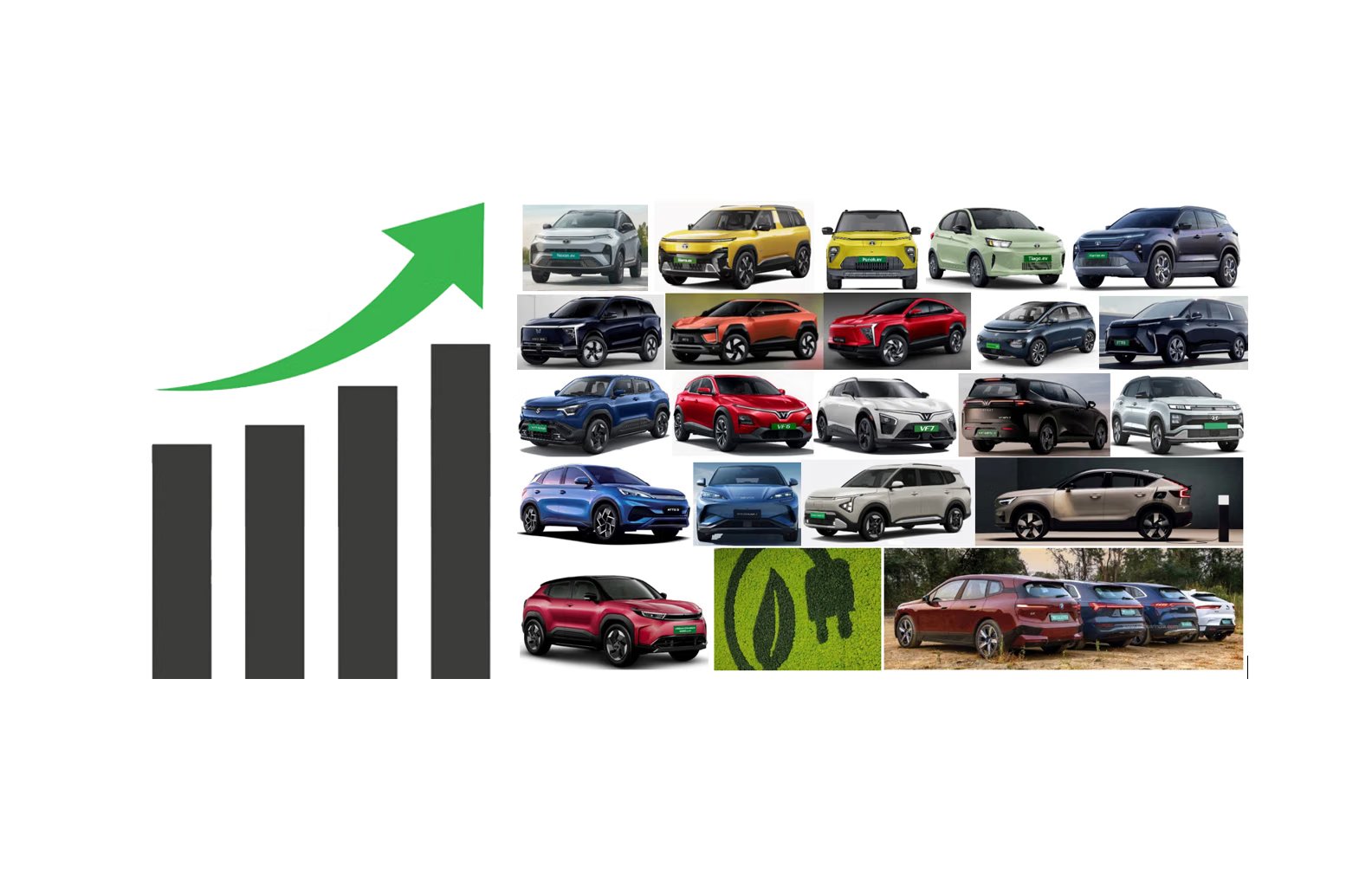
The psychological tipping point has arrived.
For years, prospective car buyers sat on the fence, paralyzed by range anxiety, patchy highway chargers, and fears of early battery degradation. That hesitation has broken. Official registration figures reveal that retail deliveries of electric passenger vehicles across India have breached the 300,000 mark for the first time in history. Between January 1 and November 9, buyers registered 304,701 zero-emission cars, SUVs, and MPVs—a massive 66 percent jump over the same stretch last year.
The market did not merely grow. It sprinted.
With 52 days still left on the calendar, deliveries have already eclipsed CY2025’s full-year tally of 195,571 units by 109,130 vehicles. That represents a 56 percent jump over the entire prior year. Electric cars and SUVs now account for 10 percent of India's total 2.97 million EV registrations across all categories, expanding their footprint from 8 percent in 2025. Electric two-wheelers continue to command the volume throne with 1.85 million units (62 percent share), while electric three-wheelers secured 785,965 registrations (26 percent) and commercial haulers registered 28,865 units (1 percent).
If current retail momentum holds through the wedding season and year-end clearance runs, India's electric passenger vehicle sector will close 2026 between 350,000 and 360,000 units.
Market Context: The passenger EV segment's surge from an 8 percent to a 10 percent share within India's broader electrified fleet signals that private buyers and fleet operators are no longer treating electric cars as secondary urban runabouts, but as viable primary vehicles.
Showroom footfalls turned into outright volume during the monsoon months.
The year opened with steady interest as first-quarter registrations clocked 63,370 units, rising 66 percent year-on-year. Momentum accelerated sharply in the second quarter, jumping 39 percent sequentially to 88,040 units—up 40 percent against Q2 2025. Then came the third-quarter floodgates. Between July and September, dealers handed over 104,744 electric passenger vehicles, an 87 percent surge over Q3 2025.
Deliveries breached 30,000 units every month starting in June. September set the all-time monthly benchmark with 38,440 registrations, exploding 108 percent year-on-year.
| Quarter / Period | Retail Sales (Units) | YoY Growth (%) | Share / Key Milestone |
|---|---|---|---|
| Q1 (Jan–Mar) | 63,370 | +66% | Strong opening baseline |
| Q2 (Apr–Jun) | 88,040 | +40% | Crossed 30,000/month threshold in June |
| Q3 (Jul–Sep) | 104,744 | +87% | Record quarter; September peaked at 38,440 |
| Q4 (Oct–Nov 9) |
October sustained that high-voltage run with 37,516 deliveries, while the first nine days of festive November added another 10,031 cars to the road.
Choice has detonated across dealer showrooms. Three manufacturers—Tata Motors, Mahindra & Mahindra, and JSW MG Motor—now hold a stranglehold over 81 percent of the total market, but the rivalry between them has turned ferocious.
Tata Motors stands unchallenged at the top. It became the first automaker in India to retail more than 100,000 electric vehicles in a single calendar year, crossing the milestone at the end of September. YTD deliveries stand at 120,895 units—a 58 percent surge over its CY2025 total of 76,644 cars. That hands Tata a commanding 40 percent market share. The Nexon EV continues to shoulder the lion's share of volume, backed by rising demand for the refreshed Tiago EV and Punch EV. In September alone, Tata moved 15,719 electric cars, capturing 41 percent of the national total.
Mahindra, however, staged the year's fiercest counteroffensive. Selling 69,660 electric SUVs, M&M wrested the second-place spot with a 23 percent market share—a substantial jump from its 19 percent share and 37,247 units in 2025. October was its high-water mark, recording 8,702 SUV deliveries. Mahindra's offensive relies on a widening portfolio comprising the BE 6, XEV 9e, XEV 9S, and XUV 3XO EV. To lower purchase barriers, Mahindra extended its Battery-as-a-Service (BaaS) ownership program to both the XEV 9S and XEV 9e, splitting initial sticker prices from pack rental fees.
That aggression pushed JSW MG Motor down to third place. MG delivered 56,988 units year-to-date, capturing a 19 percent share—slipping from the 29 percent share it controlled in CY2025 when it logged 57,239 sales. The company needs just 252 units to surpass its 2025 total. The Windsor EV continues to anchor MG's volume, while the newly launched Hector Tomahawk EV expands its presence. MG also rolled out its own BaaS structure to premium flagships like the Cyberster and M9.
Together, Tata and Mahindra alone command 62 percent of India's electric car sales.
| Manufacturer | CY2026 YTD Sales | Market Share (%) | Key Drivers & Highlights |
|---|---|---|---|
| Tata Motors | 120,895 | 40% | First to breach 100k; Nexon EV, Punch EV, Tiago EV |
| Mahindra & Mahindra | 69,660 | 23% | Rose to No. 2; BE 6, XEV 9e, XEV 9S, XUV 3XO EV, BaaS model |
| JSW MG Motor | 56,988 | 19% | Ceded No. 2 rank; Windsor EV leads; Hector Tomahawk EV added |
Outside the podium, fresh capital and new nameplates are unsettling traditional brand hierarchies.
Vietnam's VinFast pulled off the year's biggest surprise. Entering India just 15 months ago, the newcomer seized fourth position with 15,867 registrations, locking down 5 percent of the market. Its localized portfolio—the VF6, VF7, VF MPV 7, and the commercial Limo Green fleet taxi—found swift traction, peaking in September with 3,305 deliveries.
Maruti Suzuki took fifth spot with 12,390 registrations of its e-Vitara SUV, capturing a 4 percent market share. The e-Vitara saw its peak in June at 2,010 units. Maruti is now preparing to push domestic delivery volumes higher as commercial assembly begins at its Hansalpur plant in Gujarat.
Kia climbed to sixth position with 7,612 deliveries (2.49 percent share), comfortably beating its 2025 total of 3,094 cars. The launch of the Syros EV in August transformed its numbers. Kia crossed the four-figure monthly delivery mark for the first time in September (1,440 units) and repeated it in October (1,413 units), outselling Maruti Suzuki in both months. The Korean brand complements the Syros EV with the Carens Clavis EV, alongside fully imported halo models like the EV6 and EV9.
Chinese giant BYD slipped to seventh rank with 6,755 units (2 percent share), down from fifth in 2025 despite an expanded portfolio featuring the Atto 3, eMax 7, Seal, and Sealion 7. Its strongest month came in June with 940 units.
Hyundai Motor India slid to eighth place. Having sold 7,376 units for fourth rank in 2025, Hyundai registered 6,013 units this year across the Creta Electric and Ioniq 5, capturing a 2 percent market share. August (845 units) and September (844 units) marked its strongest delivery windows.
Further down, Toyota Kirloskar Motor took 12th place with 762 registrations of its Urban Cruiser Ebella, going head-to-head against the Mahindra BE 6, MG ZS EV, and Creta Electric. Stellantis rounded out the mainstream field, delivering 436 units of the Citroen e-C3.
Affluent buyers are switching powertrains just as decisively.
Luxury electric car sales jumped 29 percent to 7,323 units across nine manufacturers, up from 5,669 cars in CY2025. High-end battery models now account for 2.40 percent of all electric cars sold nationwide.
BMW dominates the luxury tier. The Munich brand delivered 4,273 electric vehicles, securing an overwhelming 58 percent luxury EV share. That comfortably beat its CY2025 mark of 3,481 units. BMW reinforced its grip in September by adding the i5 Long Wheelbase, while pushing updated iterations of the 7 Series and i7 sedans.
Mercedes-Benz retained second spot with 1,416 registrations (19 percent luxury share), slipping from 1,455 units and a 26 percent share in CY2025.
Tesla seized third place in its debut push, crossing four figures with 1,153 deliveries (16 percent share) driven by the Model Y and Model Y L. September was Tesla's strongest month at 300 deliveries, pushing the American automaker ahead of Mercedes-Benz for two consecutive months.
Volvo took fourth among luxury marques with 383 units (5 percent share). Boutique and ultra-luxury nameplates absorbed the balance: Porsche delivered 83 cars, Rolls-Royce handed over 6, JLR logged 4, Lotus moved 3, and Audi registered 2.
With production capacity ramping up at Hansalpur and year-end corporate tax-deduction buying entering its final sprint, the race to 360,000 units is now fully engaged.
| 47,547 |
| — |
| 37,516 in Oct; 10,031 in first 9 days of Nov |
| CY2026 YTD Total | 304,701 | +66% | Surpassed full-year CY2025 (195,571) by 56% |
| VinFast |
| 15,867 |
| 5% |
| 4th place; VF6, VF7, VF MPV 7, and Limo Green fleet taxi |
| Maruti Suzuki | 12,390 | 4% | 5th place; driven entirely by e-Vitara SUV |
| Kia India | 7,612 | 2.49% | 6th place; Syros EV launch propelled 1,000+ monthly run rate |
| BYD India | 6,755 | 2% | 7th place; Atto 3, eMax 7, Seal, Sealion 7 |
| Hyundai Motor India | 6,013 | 2% | 8th place; Creta Electric and Ioniq 5 |
| Toyota Kirloskar | 762 | <1% | 12th place; Urban Cruiser Ebella |
| Stellantis India | 436 | <1% | Mainstream tail-ender; Citroen e-C3 hatchback |