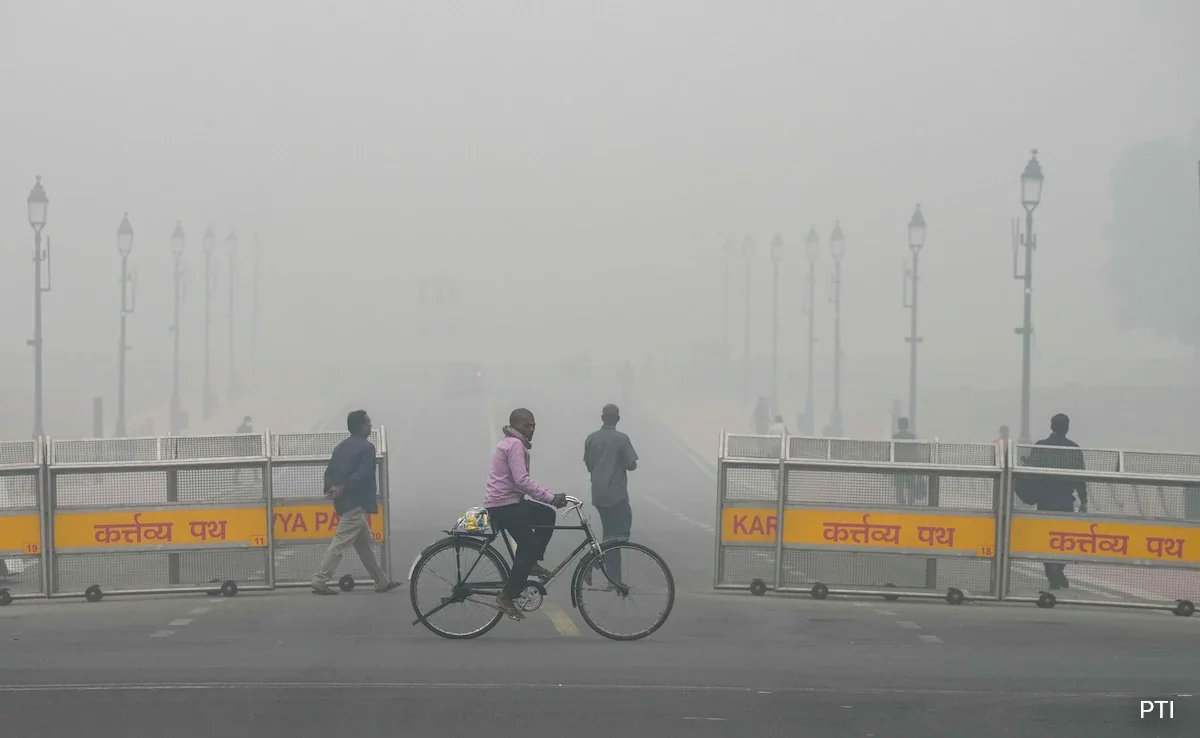
A brief spell of brisk wind offered the national capital barely twenty-four hours of respite.
Delhi’s air quality plunged straight back into the 'very poor' band on Wednesday, as the city's 24-hour average Air Quality Index settled at 313, up from 299 the previous day. The Central Pollution Control Board tracks the metric across the capital, marking a swift reversal after Tuesday's fleeting dip into 'poor' territory. Particulate matter PM10 emerged as the predominant pollutant choking the metropolis, blanketing neighborhoods in a stubborn haze. Relief vanished fast. Out of 58 monitoring stations transmitting live data across Delhi, 34 registered 'very poor' readings, 22 logged 'poor', and one breached the critical 'severe' mark. Delhi Cantonment recorded the lone pocket of clean air, managing a 'moderate' reading of 117.
Pollution dynamics are shifting rapidly over the capital's skies. Modeling run by the Indian Institute of Tropical Meteorology shows vehicular emissions drove Wednesday's toxic haze, with the transport sector accounting for the single largest share of local pollution. Stubble burning in neighboring states contributed roughly 7 per cent to Delhi's foul air on Wednesday. That calculation will not hold. Projections developed by the Decision Support System warn that the farm fire share could surge nearly threefold to 20 per cent by Thursday, while transport emissions taper marginally to 13 per cent.
Both fine particulate matter PM2.5 and coarser PM10 concentrations will climb steadily across the region over the coming 48 hours, according to the Air Quality Early Warning System. The atmosphere is turning stagnant. Dispersal conditions have withered, trapping ground-level exhaust and agricultural smoke directly over the National Capital Region.
| Atmospheric & Regional Burn Parameters | Official Metric / Recorded Status |
|---|---|
| Citywide 24-Hour Average AQI | 313 ('Very Poor') |
| Prior Day Baseline AQI | 299 ('Poor') |
| Stations in 'Very Poor' Category | 34 out of 58 active stations |
| Stations in 'Severe' Category | 1 station |
| Cleanest Monitored Location | Delhi Cantonment (AQI 117, 'Moderate') |
| Transport Sector Contribution (Tuesday) | 17 per cent |
| Transport Contribution (Projected Thursday) | 13 per cent |
| Farm Fire Smoke Share (Wednesday) | 7 per cent |
Satellite eyes tracking North India recorded a severe flare-up in open crop residue burning on Tuesday. Data captured by the Consortium for Research on Agroecosystem Monitoring and Modelling from Space Laboratory, operated by the Indian Agricultural Research Institute, detected 927 separate fires across six northern and central states in a single day.
Farmers in Madhya Pradesh logged the highest count with 376 fires, while Punjab recorded 345 incidents. Uttar Pradesh documented 119 crop burning events, followed by Rajasthan with 64, Haryana with 14, and Uttarakhand with nine. The single-day surge lifted cumulative detections across the six monitored states to 9,592 incidents between September 15 and November 10. Smoke from these fields is drifting southeast straight toward Delhi's geographic basin.
Atmospheric surveillance teams and municipal enforcement units are scheduled to review regional containment measures on Thursday as farm fire plumes converge over the capital.
| Farm Fire Smoke Share (Projected Thursday) | 20 per cent |
| Six-State Single-Day Farm Fires (Tuesday) | 927 satellite detections |
| Cumulative Farm Fires (Sept 15 – Nov 10) | 9,592 incidents |