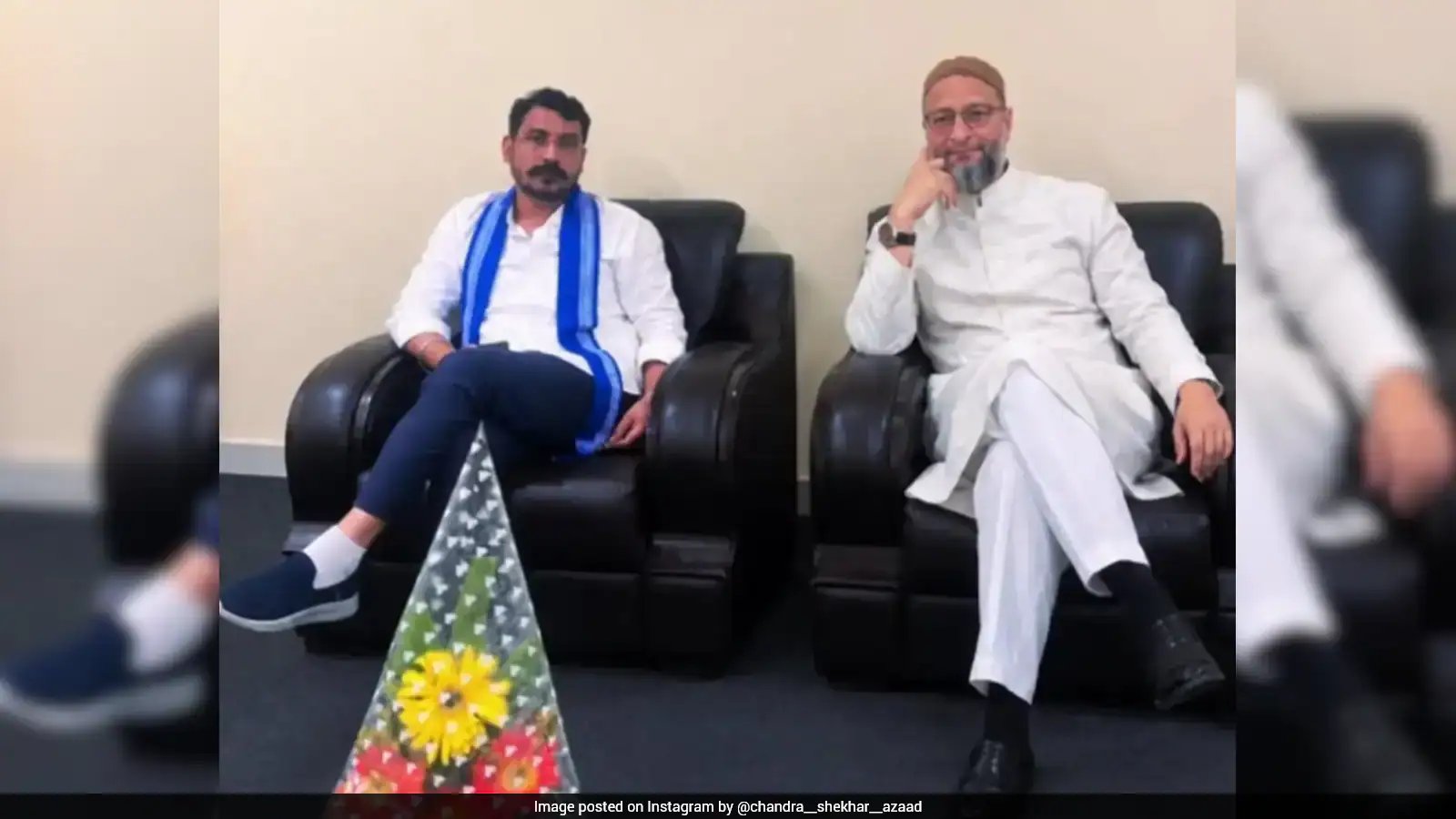
Asaduddin Owaisi landed in Lucknow on Wednesday to lock down an electoral alliance with Chandrashekhar Azad’s Azad Samaj Party (Kanshi Ram) ahead of the Uttar Pradesh assembly polls scheduled for February 2027.
The pact was sealed.
Both party leaderships finalized the arrangement following several rounds of closed-door negotiations. Owaisi’s All India Majlis-e-Ittehadul Muslimeen (AIMIM) and Azad’s ASP plan to announce the coalition formally at a joint press conference in Lucknow on Thursday. The partnership stitches together a party seeking to mobilize Muslims with an organization building a militant Dalit cadre, creating an explicit third front outside both the ruling Bharatiya Janata Party-led National Democratic Alliance and the Samajwadi Party-led opposition bloc.
AIMIM turned to Azad only after established opposition outfits slammed the door in its face.
Uttar Pradesh AIMIM president Shaukat Ali confirmed the party sought partnerships across the board before striking terms with Azad. Ali said the party approached Akhilesh Yadav's Samajwadi Party, the Congress, and Mayawati’s Bahujan Samaj Party, only to face uniform rejections from all three.
"We have always wanted a strong alliance to be formed so that the BJP does not come to power in Uttar Pradesh for a third term," Ali said. "Muslims have suffered the most under the BJP government."
Ali pointedly dismissed the Samajwadi Party's ability to unseat the government on its own, citing historical electoral collapses.
I don't know in what dream Akhilesh Yadav is living. As far as I can see, this SP
Congress alliance is the same alliance that fought the 2017 Uttar Pradesh election, and the result will be the same." — Shaukat Ali, Uttar Pradesh President, AIMIM
Ali cited the 2025 Bihar assembly elections to justify the break, noting that the BJP-JD(U) alliance retained power after the Rashtriya Janata Dal and Congress refused an alliance with Owaisi’s Hyderabad-headquartered outfit.
Azad, who won the Nagina Lok Sabha seat in 2024 to become his party’s sole member of Parliament, trained his fire directly on Lucknow's governance record. He insisted the alliance would focus squarely on marginalized labor and agricultural communities.
"Issues like vote theft are before us. We are still suffering the consequences of demonetisation, but the bigger concern is the declining number of government jobs," Azad said. "Educated young people from Dalit and backward communities are struggling despite having degrees."
Akhilesh Yadav brushed off the tie-up when confronted by reporters in Lucknow.
"The people of Uttar Pradesh have already made up their minds in favour of the Samajwadi Party," Yadav said.
Neither organization carries a winning legislative track record in the state assembly. The past numbers are grim.
During the 2022 Uttar Pradesh assembly elections, AIMIM fielded candidates in over 90 constituencies and took home less than 0.5 percent of the total vote. The Azad Samaj Party ran over 100 contestants and polled just 0.13 percent. Azad himself challenged Chief Minister Yogi Adityanath in Gorakhpur Urban, where he mustered fewer than 8,000 votes and surrendered his election deposit.
| Party & Election Parameter | 2022 Assembly Contests | 2022 Vote Share | 2024 General Election Status |
|---|---|---|---|
| All India Majlis-e-Ittehadul Muslimeen (AIMIM) | Over 90 seats | Under 0.50% | Zero seats won in UP |
| Azad Samaj Party (Kanshi Ram) | Over 100 seats | 0.13% | Won Nagina Lok Sabha constituency |
Yet the strategic arithmetic shifts sharply when local district populations align. Muslims make up approximately 19 percent of Uttar Pradesh’s population, while Scheduled Castes account for roughly 21 percent. Combined, the two demographics form a formidable 40 percent bloc across the state, climbing far higher in specific pockets of western Uttar Pradesh.
In Rampur, Muslims comprise roughly 50 percent of the populace, while Dalits make up 13 percent. In Moradabad, the two communities combine to form over 60 percent of local voters. Saharanpur presents a similar stronghold, with Dalits representing over 20 percent and Muslims exceeding 40 percent.
| Target District | Muslim Population Share | Dalit Population Share | Combined Demographic Total |
|---|---|---|---|
| Rampur | ~50% | ~13% | ~63% |
| Moradabad | High concentration | High concentration | Exceeds 60% |
| Saharanpur | Over 40% | Over 20% | Exceeds 60% |
| Amroha & Sambhal |
Bijnor holds multiple assembly segments nested within Azad’s Nagina parliamentary territory where this demographic balance dominates. In Amroha and Sambhal, the two communities together command over 50 percent of the electorate. Alliance strategists have mapped similar targets across roughly a dozen assembly constituencies spanning Bahraich, Shravasti, Bareilly, Meerut, Azamgarh, and Mau.
The pact cuts straight into Akhilesh Yadav's core electoral playbook.
The real test now shifts to seat negotiations.
Both parties must demonstrate whether street-level coordination can overcome deep organizational deficits on the ground. Owaisi and Azad will detail their joint operational strategy, committee formations, and campaign schedules at their joint press briefing in Lucknow on Thursday morning.
| Regional majority |
| Regional plurality |
| Exceeds 50% |