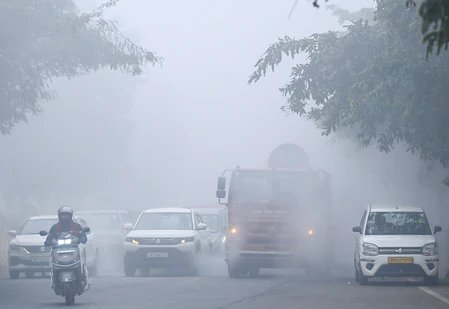
NEW DELHI — Toxic haze tightened its grip on the National Capital Region weeks before the first festival firecracker was lit.
Average concentrations of fine particulate matter (PM2.5) across Delhi-NCR touched 236 micrograms per cubic meter during the week preceding Diwali in 2026. That marks the dirtiest pre-Diwali air recorded in three years. It represents a staggering 97% surge over the 120 micrograms per cubic meter logged during the corresponding period in 2025. It also eclipses the 2024 reading of 179 micrograms per cubic meter by 32%.
The numbers point to an alarming shift. The baseline itself has soured.
The findings, released in a study by the Centre for Science and Environment (CSE), trace the worsening autumn air across October and mid-November 2026. Analysts combined real-time air quality feeds from the Central Pollution Control Board (CPCB) portal, source apportionment modeling from the Indian Institute of Tropical Meteorology (IITM), and live traffic congestion indexes supplied by TomTom.
Pollution around Diwali serves as a critical 'tipping point' every year. However, the elevated levels of particulate matter observed even before the festival this year indicate that the baseline level of pollution is higher compared to previous years.
Anumita Roychowdhury, Executive Director of Research and Advocacy, CSE
Among all internal polluters operating within regional borders, tailpipes inflicted the heaviest blow.
CSE's sector assessment found that local transportation remains the single largest emitter choking the capital's breathing zone. Commuter congestion indexes confirmed that everyday exposure to toxic air stems overwhelmingly from bumper-to-bumper traffic. Vehicles sat idling on choked arterial corridors for hours, spewing concentrated plumes directly into populated neighborhoods.
Emergency interventions cracked under pressure.
Authorities had clamped prohibitions on older pre-Bharat Stage VI (pre-BS-VI) vehicles to arrest the annual descent into smog. Yet the restrictions failed to thin traffic density or loosen gridlock across critical bottlenecks. Volumes held firm. Tailpipe exhaust accumulated beneath low atmospheric mixing heights, trapping commuters in stagnant swathes of toxic air.
| Year (Pre-Diwali Week) | Average PM2.5 Level (µg/m³) | Year-on-Year Trajectory |
|---|---|---|
| 2024 | 179 µg/m³ | Baseline benchmark |
| 2025 | 120 µg/m³ | 33% decline from 2024 |
| 2026 | 236 µg/m³ | 97% surge vs 2025; 32% jump vs 2024 |
Meteorology offered only a brief reprieve before autumn set in.
Late September monsoon showers washed the skies clean and pulled pollution tallies down for a few days. The respite did not hold. As temperatures dipped heading into October, particulate loads rebounded violently.
"In both years, pollution spiked significantly a few days before Diwali," said Sharanjit Kaur, Deputy Programme Manager at CSE. "However, in the week leading up to the festival in 2026, the levels of toxic pollutants were notably higher—and the air quality worse—compared to previous years."
Smoke from northern agricultural stubble burning also drifted across agrarian belts, compounding the regional load. Yet researchers observed a telling structural breakdown: even during lulls when active farm fire counts dropped, Delhi's air quality remained stalled in the severe zone. Internal urban emissions were already dense enough to sustain crisis-grade smog entirely on their own.
Roychowdhury pointed out that year-round mitigation frameworks have failed to enforce structural reductions at key emission sources. Had regional air been scrubbed cleaner at the start of winter, she noted, seasonal triggers would not have driven the capital's atmosphere past the breaking point.
Environmental authorities are scheduled to review air pollution containment targets and inter-state traffic compliance protocols before regional winter temperatures reach their annual low.