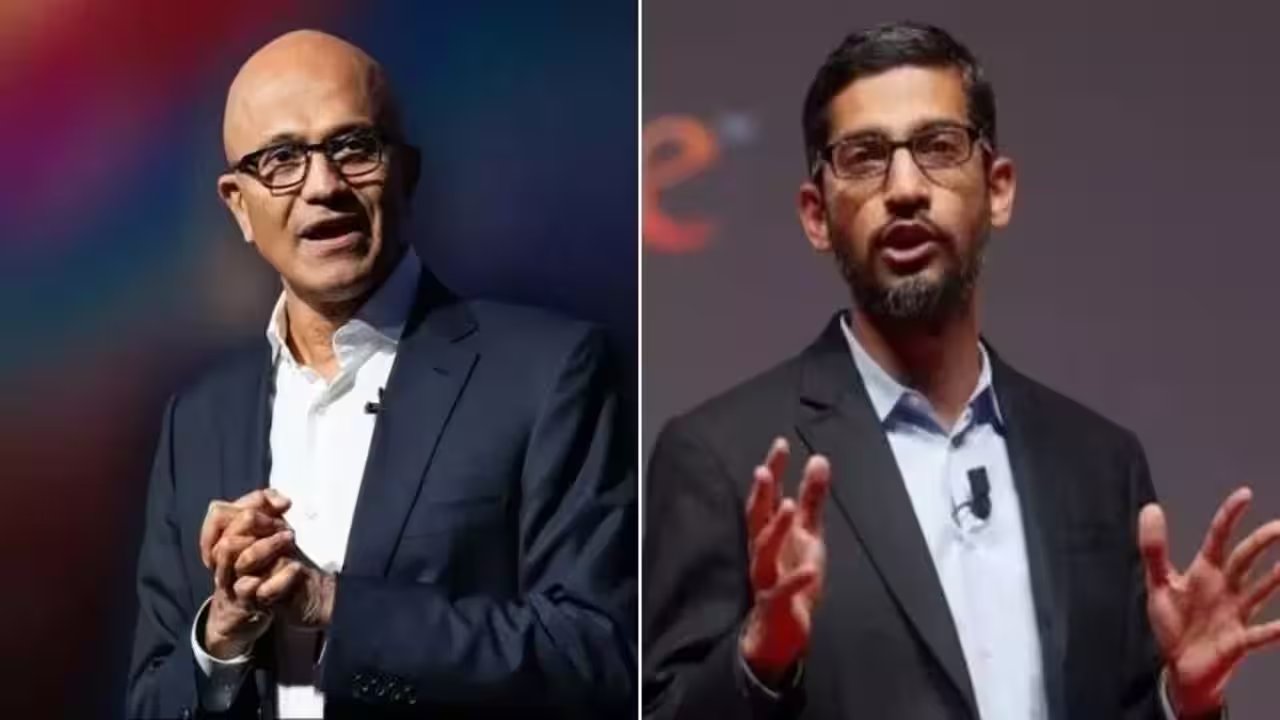
Global corporations steered by Indian-origin business leaders have crossed a combined market value of $15 trillion.
Silicon Valley's artificial intelligence gold rush fueled the surge. Two years ago, these enterprises commanded $9.9 trillion. That figure leaped 53% by the June 25 cut-off date documented in the newly published HSBC Hurun Global Indians List 2026, solidifying the diaspora's grip on the commanding heights of global industry. Sundar Pichai anchors the summit, steering Alphabet to a $4.2 trillion valuation. Microsoft, commanded by Satya Nadella, follows in second position at $2.6 trillion. Semiconductor giant Micron Technology, led by chief executive Sanjay Mehrotra, rounds out the top tier at $1.4 trillion.
Beyond capital market valuations, their operational footprint rivals the output of major sovereign states. Together, the 200 ranked firms generate $2.5 trillion in annual revenue and employ 53 lakh workers worldwide.
Corporate balance sheets now mirror the aggressive rollout of commercial AI architectures. More than half of the ranked enterprises—103 companies in total—either operate as direct artificial intelligence developers or have integrated the technology across primary lines of business.
The numbers tell the story. Those 103 AI-integrated companies command $10.7 trillion, accounting for 71% of the entire $15 trillion portfolio. Chip production, enterprise software, and hyper-scale cloud computing hubs directed by these executives now process a dominant share of global enterprise workloads.
The reach of the global Indians is something most people experience without realising it.
Anas Rahman Junaid, Founder and Chief Researcher, Hurun India
Breaking into the elite cohort required unprecedented capital scale this cycle. Hurun doubled the entry threshold to $2.5 billion, up sharply from the $1.2 billion floor established just two years prior. Despite that stiff hurdle, 76 companies secured debut rankings. Across the full 200-firm index, 127 trade on public bourses, 73 operate as privately held corporations, and 49 function as venture-backed startups holding a collective valuation of $398 billion.
| Benchmark Metric | Official 2026 List Data | Prior Baseline (Two Years Ago) | Change |
|---|---|---|---|
| Combined Valuation | $15 Trillion | $9.9 Trillion | +53% |
| AI-Linked Corporate Value | $10.7 Trillion (71% of total) | Unspecified baseline | Core growth driver |
| Minimum Valuation Threshold | $2.5 Billion | $1.2 Billion | +108% |
| Annual Enterprise Revenue |
Power remains heavily concentrated on the American Pacific rim. The United States accounts for 177 of the 236 tracked executives, with the state of California housing more than a third of the entire roster. San Francisco ranks first among global cities with 40 diaspora leaders. Dubai captured second place with 15 corporate chiefs, while Palo Alto and London tied with 13 leaders apiece.
Corporate climbing frames also reveal distinct career pathways. Salaried professionals account for 53% of the 236 executives, proving that institutional stewardship at firms like Alphabet and Microsoft remains the primary path to top-tier influence. First-generation entrepreneurs comprise 44% of the index, while second-generation business leaders represent the remaining 3%.
Specific academic corridors continue to channel talent directly into international executive suites. The Indian Institute of Technology Delhi led all undergraduate institutions by graduating 15 executives on the list. For postgraduate education, Stanford University claimed the top spot globally, counting 19 tracked leaders among its alumni network.
Executive focus now pivots to the 2026 earnings cycle as mega-cap technology leaders face sustained investor scrutiny over return on enterprise AI capital expenditures.
| $2.5 Trillion |
| Unspecified baseline |
| Scale footprint |
| Global Workforce Employed | 53 Lakh (5.3 Million) | Unspecified baseline | Direct headcount |
| Debut Companies | 76 Firms | N/A | New entrants |
| Startups Tracked (49 Firms) | $398 Billion | Unspecified baseline | Disruptor class |