European waters averaged 21.6°C from June through August, the highest summer mean in the 45-year record stretching back to 1982. It is a number that does not just sit on a chart. It burns. The Bay of Biscay, hugging the coasts of France and northern Spain, felt the heat most acutely, with temperatures climbing to 21.4°C—more than 2.4°C above the 1991-2020 baseline. By late August, the region had logged 186 days of marine heatwave conditions, a prolonged stressor that leaves little room for recovery.
The damage is visible from the shore. In Asturias, marine ecologist Jose Manuel Rico Ordas reports that approximately 95 percent of the brown kelp stands sampled since 2010 have vanished. These underwater forests are not just scenery; they are the nursery and pantry for sea urchins, lobsters, and crayfish. When 95 percent of that infrastructure collapses, the food web unravels. Species adapted to cooler waters face immediate pressure, while others scramble to find new ground.
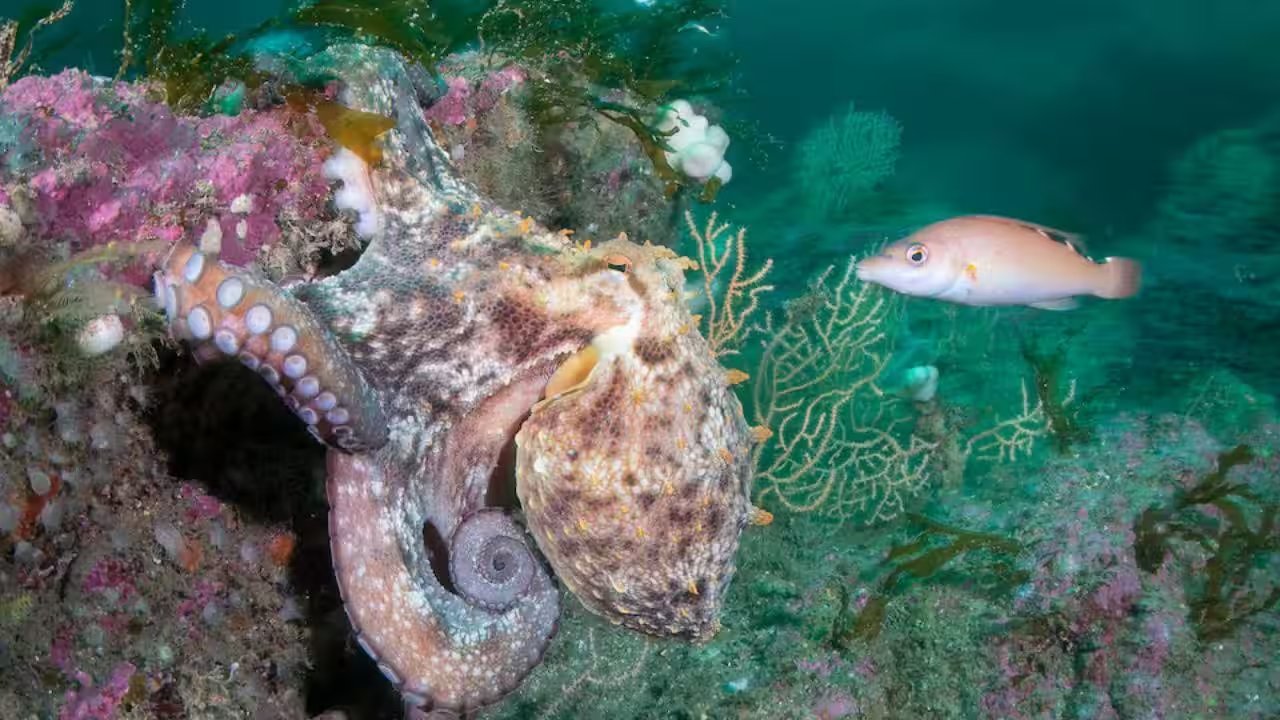
Southern England offers a stark counterpoint of abundance born from chaos. Common octopus landings, which languished below 30 tonnes annually before 2025, spiked to roughly 2,600 tonnes in 2025 and have already crossed 3,000 tonnes in 2026. For some fishermen, this is a windfall. For others, it signals a loss. Traditional catches of crab, lobster, and scallops are declining as the thermal shift forces a redistribution of the marine population.
In the Mediterranean, the warming waters are acting as a gateway for non-native species, adding to the strain on already fragile local food chains. Scientists attribute these shifts to increasingly frequent and intense heatwaves that disrupt survival and reproduction cycles. As temperatures continue their upward trajectory, the line between 'unusual' and 'normal' in Europe's oceans keeps redrawing itself, leaving little time for ecosystems or economies to adapt.