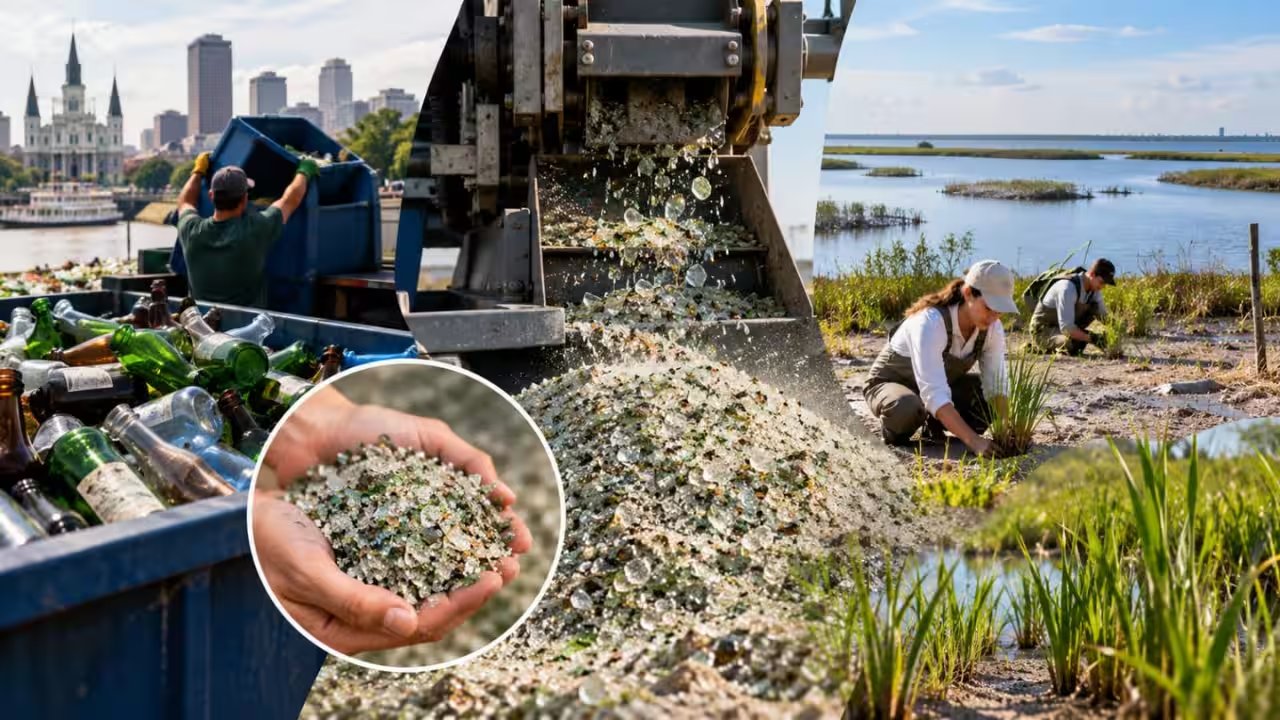
In February 2026, Tulane University announced that Glass Half Full had removed more than 12 million pounds of discarded bottles from New Orleans landfills. The program, launched in 2020 by students Franziska Trautmann and Max Steitz, now processes about 2 tons of glass per hour. Trautmann said the increased throughput lets the organization supply up to 500 tons of recycled sand annually for restoration projects.
The crushed glass is blended with native river sediment to create a substrate that can support wetland plants. Dr. Rajiv Kumar, a Tulane coastal ecologist, explained that the glass sand’s angularity improves drainage while the fine particles retain nutrients. This mix is being tested in the ReCoast research program, which unites ecologists, engineers, and restoration practitioners.
Researchers are comparing vegetation growth on four constructed islands east of New Orleans—two built with dredged river sand and two with a 50‑50 mix of river sand and Glass Half Full glass sand. Early data show similar root density but slower canopy development on the glass‑mixed islands, prompting scientists to tweak the blend with nutrient‑rich river sediment and beneficial microbes.
Tulane plans to publish full findings in the Journal of Coastal Research in June 2026 and will lobby the Louisiana Department of Environmental Quality to adopt recycled glass as an approved restoration material. If approved, the state could mandate the use of glass sand in future wetlands projects, potentially saving millions of dollars in dredged sediment costs.