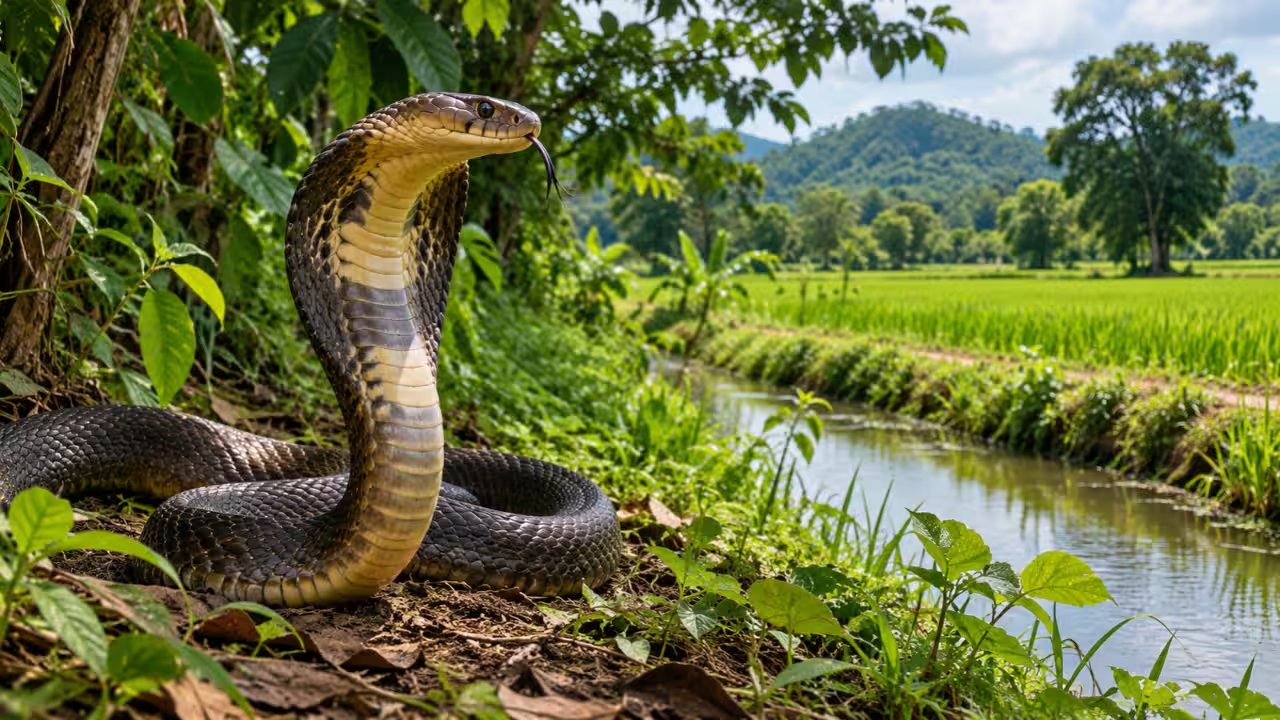
Seven king cobras in northeastern Thailand can barely move. Published in Movement Ecology, a new study from Sakaerat Biosphere Reserve documents how these massive snakes are physically hemmed in by rice paddies, cornfields, and a four-lane highway linking Nakhon Ratchasima to Bangkok. Between March 22, 2014, and July 28, 2018, researchers implanted radio transmitters in the animals, logging their positions four times daily. The data is stark: movement velocity dropped significantly in agricultural areas compared to forested zones. The snakes didn’t just slow down; they relied on narrow strips of scrub and vegetation along irrigation canals to cross farmland where natural habitat has been shattered.
The landscape here is a collision course for wildlife. The study area includes a protected forest core and a buffer zone, but the transitional zone is dominated by farming and 159 villages. King cobras, among the largest venomous snakes on Earth, face a reality where their range is chopped into isolated pockets. The researchers noted that while some snakes avoided roads, others used them, showing no consistent pattern of avoidance. This lack of uniformity complicates conservation efforts. One snake spent 100% of its tracked time in human-disturbed areas; another spent only 0.7%. Individual behavior varies wildly, making blanket protection strategies ineffective.
Weirdly, the snakes didn’t flee human settlements. They spent an average of 2.3 days at shelter sites and returned to previously used locations roughly every 13 days. The study found no correlation between distance to landscape features and shelter duration. Instead, the snakes clung to semi-natural vegetation—field margins, disused plots, and canal banks. These strips likely offer cover and prey, though the team didn’t directly measure prey abundance. The key takeaway is that irrigation canals act as lifelines, connecting isolated forest fragments in a sea of agriculture.
The implications for conservation are specific. The authors argue that protecting these linear habitats is critical for king cobra survival outside protected areas. They recommend road-crossing structures combined with fencing to reduce vehicle collisions. Human-snake conflict remains a major threat, with persecution and direct mortality high in farmed zones. The researchers stress the need for improved, humane snake-removal services to reduce the incentive for villagers to kill the animals. This isn’t just about saving a species; it’s about managing a shared, fragmented space where 159 villages live alongside a highly dangerous predator.
The study carries a caveat: the sample size is small. Seven individuals do not represent all king cobra populations across their range. Yet, the pattern is clear. Fragmentation restricts movement. Canals and forest fragments are the only routes left. As farmland continues to spread across the globe, this Sakaerat model offers a blueprint. Protect the edges. Keep the canals clear. Build the crossings. Or the snakes stay trapped, and the ecosystem loses a top predator.