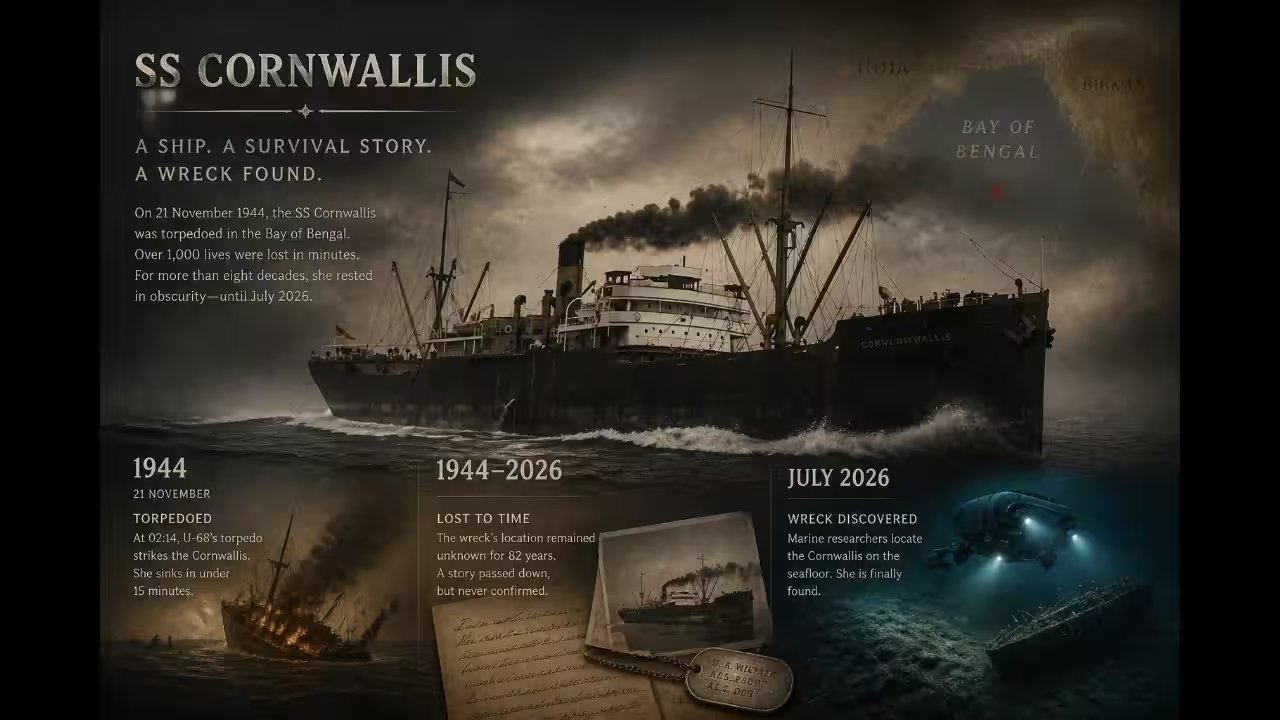
Deep-sea divers have discovered the sunken hull of the SS Cornwallis nearly 400 feet beneath the North Atlantic off the coast of Maine, resolving an 82-year maritime mystery.
The Canadian merchant vessel went down in less than ten minutes on December 3, 1944, after German submarine U-1230 slammed a torpedo into its bow. Of the 48 crew members aboard, 43 perished. Six men escaped into an open lifeboat, but exposure quickly claimed one before a passing fishing trawler pulled the remaining five from the freezing sea. For eight decades, the wreckage stayed lost in dark, offshore waters.
Then came the sonar strike on July 11, 2026. Divers from the Nomad Exploration Team, sweeping the final sector of their fifth offshore expedition since 2019, registered a clear vessel outline across their side-scan instruments. The team had crossed the same coordinates during an earlier run without detecting the hull. This pass was different. Divers dropped into the depths, examined the twisted steel framework, and matched the structural features directly against the freighter's wartime blueprints.
The discovery closed a seven-year effort that scoured over 50 square miles of seabed. Researchers built their search grids from fragmented coordinates in the ship's final distress transmission, historical tide records, and aerial debris logs compiled in December 1944.
Captained by Hans Hilbig, U-1230 prowled New England's waters on a high-stakes mission for the German naval command. Just four days before stalking the Cornwallis, the submarine covertly surfaced off the Maine shore to insert two German intelligence operatives, Erich Gimpel and William Colepaugh, onto American soil. With the spies landed, the submarine turned back toward open waters and intercepted the Canadian vessel.
The Cornwallis was steaming north from Barbados toward Saint John, New Brunswick, loaded with sugar and barrels of molasses. The strike was sudden. The warhead ripped open the forward hull, pulling the ship under before most of the crew could muster on deck.
The verification of the site provides definitive historical closure for the families of the 43 merchant mariners recorded on the Canadian Virtual War Memorial. Maritime historians and survey teams will now incorporate the confirmed coordinates into regional World War II archival maps to preserve the integrity of the offshore gravesite.