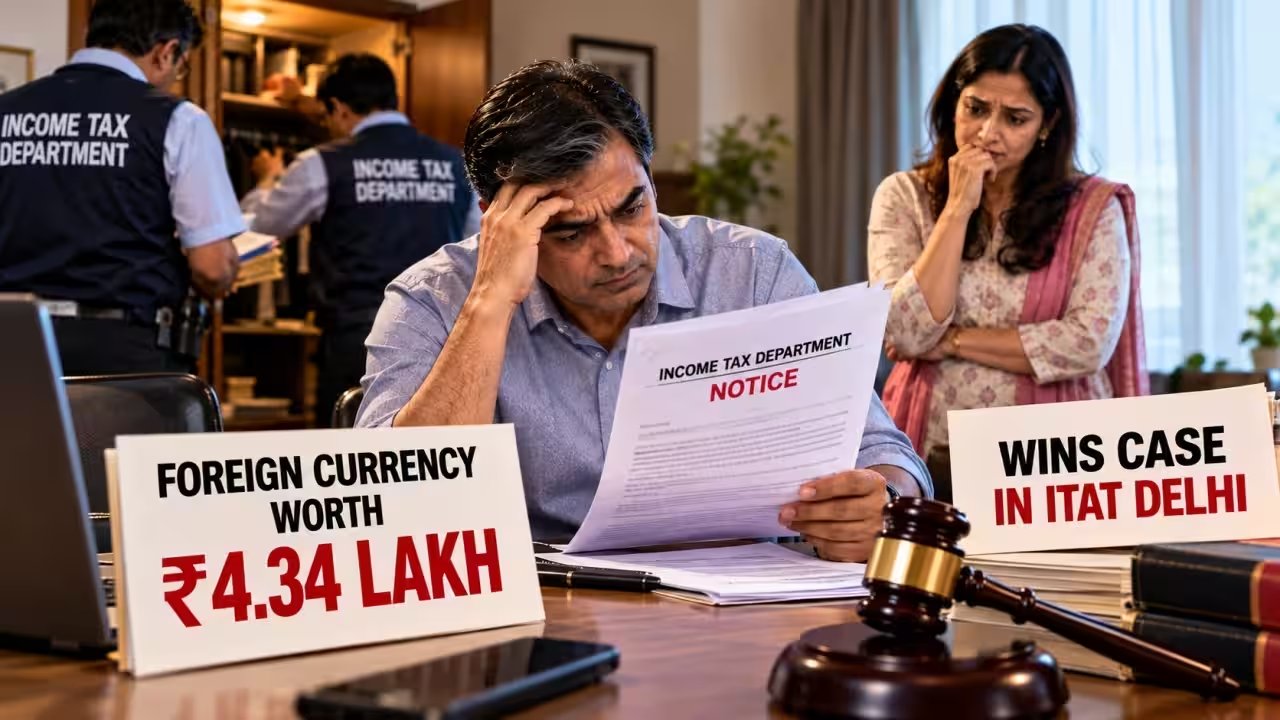
An Income Tax raid on a Delhi residence a few months after demonetisation uncovered Rs 1.12 crore in cash and Rs 4.34 lakh in foreign currency. The director claimed the money had been withdrawn from his company’s 11 bank accounts and stored at home after fears of post‑demonetisation scrutiny.
The director’s legal team presented a written statement from his sister‑in‑law, an airline employee who lived in the same house, confirming she had handed over the foreign notes for safekeeping. Her testimony explained that her frequent travel had accumulated unspent foreign currency, which she entrusted to her brother‑in‑law.
Despite the investigation team’s acceptance of the sister‑in‑law’s explanation and their decision not to seize the foreign notes, the Assessing Officer at Jhandewalan Central Circle treated both the Indian cash and the foreign currency as unexplained money under Section 69A and added them to the director’s income under Section 115BBE.
In 2023, the Income Tax Commissioner of Appeals (CIT(A)) permitted the director to exclude the Rs 1.12 crore of Indian cash from his taxable income after confirming the company’s books recorded the amount. The ITAT Delhi concurred, dismissing the AO’s objections; however, it still added the foreign currency to his income because evidence of ownership was lacking.
A fresh appeal in 2026 persuaded the ITAT to reverse its earlier stance. The tribunal found that the AO had failed to rebut the sister‑in‑law’s credible written confirmation and the investigation officers’ prior decision not to confiscate the notes. It therefore upheld the CIT(A)’s ruling and exempted the director from tax on the Rs 4.34 lakh.
Advocate Shourya Garg hailed the decision as a reminder that possession alone does not establish ownership when a paper trail and corroborating evidence exist. The ruling reinforces the principle that foreign currency up to $2,000 (or its equivalent) can be held legally by Indian residents, provided it is properly documented.