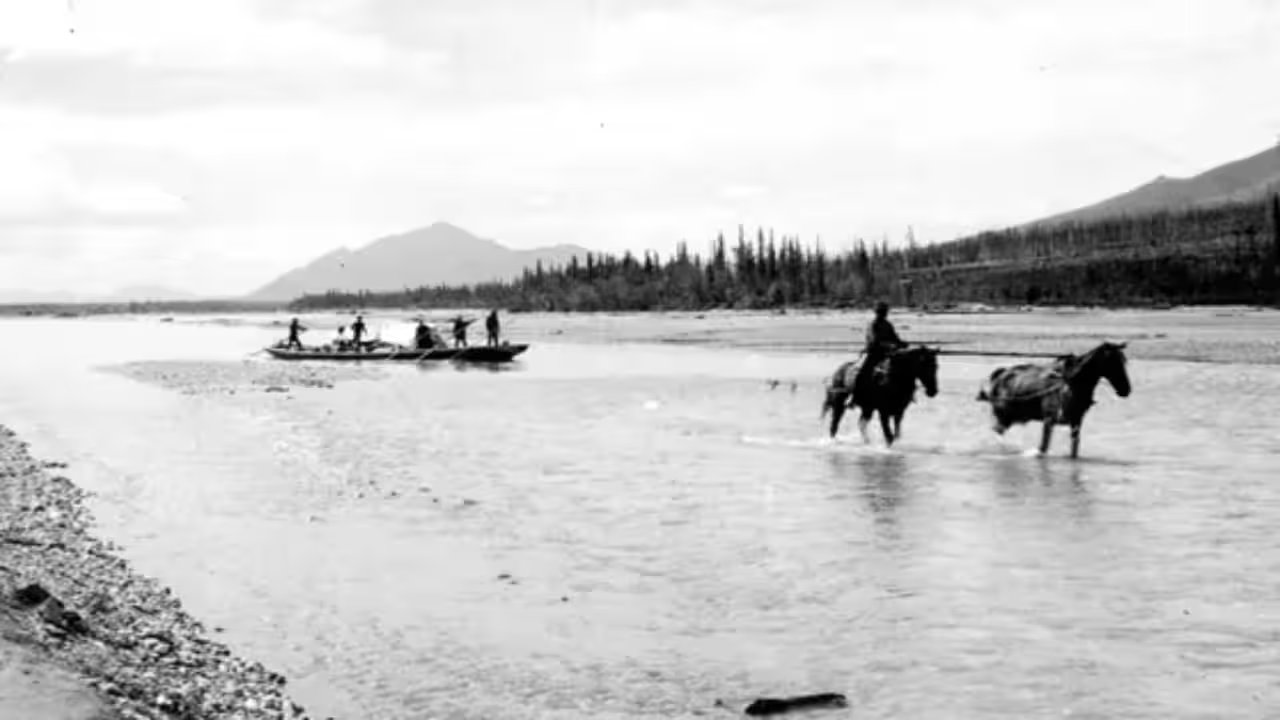
The 1898 arrival of about seventy small steamers on the Koyukuk River set in motion a gold rush that would bring in over $4 million in placer mining by 1918.
The fleet, described by a 1921 article in The Pathfinder magazine, carried mostly eastern U.S. prospectors, many of whom abandoned their boats after a single winter, leaving only a handful of seasoned miners to push the vessels 600 miles up the river.
Myrtle and Emma Creeks were among the first to yield, together netting more than $100 k in the first few years, while Nolan Creek’s 400‑foot stretch produced close to $400 k and yielded nuggets worth $865 and $714.
Gold in Nolan’s tributaries began in autumn 1903, adding $25 k that winter, then $140 k in 1904‑05, and the valley continued to deliver a steady stream of finds, with a 150‑ounce nugget sold for $2,700 in 1912.
But no continuous paystreak ever emerged. The high cost of supplies and the shrinking population by 1921 forced most miners to leave, and the towns of Koyukuk, Bergman and Bettles dwindled to ghost status.
Today the remaining towns of Wiseman, Coldfoot and the ghost town of Old Bettles stand as quiet memorials; the Koyukuk area is now managed by the National Park Service, preserving the remnants of the once‑booming district for researchers and nostalgia seekers.