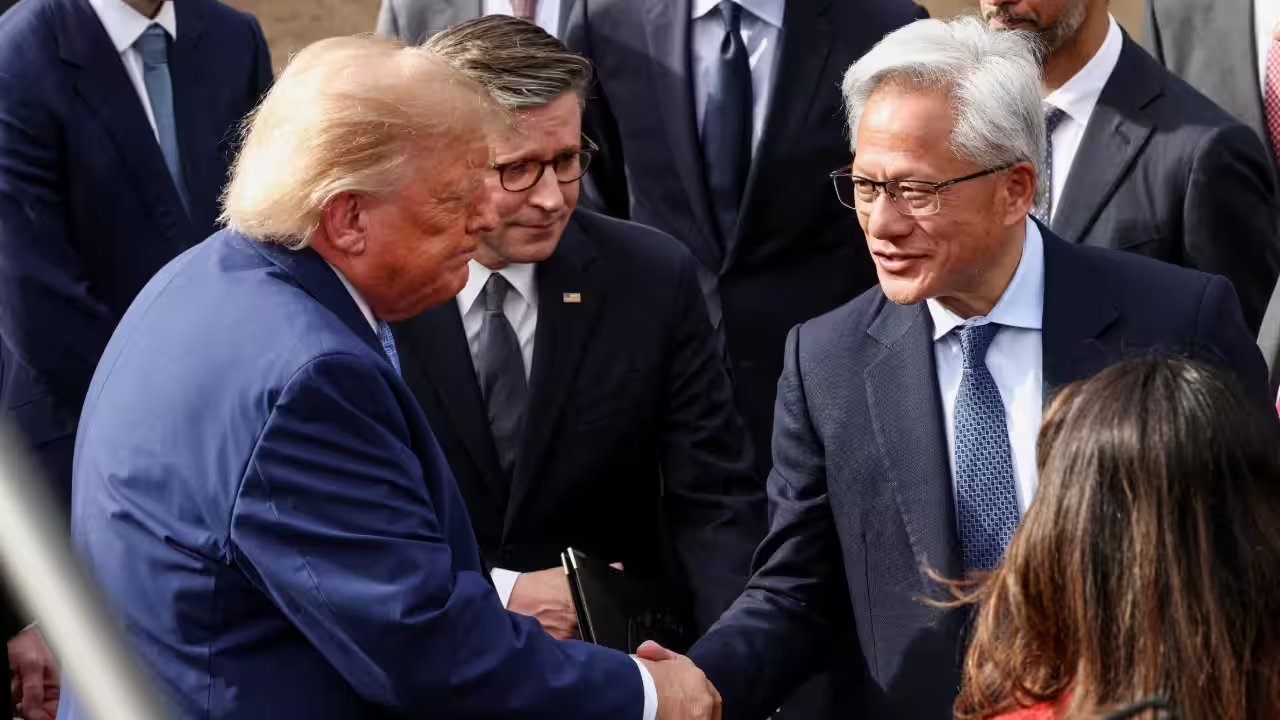
WASHINGTON — US President Donald Trump insisted he does not recall reading a high-level intelligence memo from Secretary of State Marco Rubio that warned of Nvidia chief executive Jensen Huang’s relationship with an accused Chinese operative.
The warning barely registered. Speaking to reporters at the White House, Trump acknowledged the intelligence alert may have reached his desk before his May trip to Beijing, but insisted it left no impression. "I would certainly check with the intelligence people. It could have been mentioned. Certainly, it didn't make much of an impact on me," Trump said, brushing aside questions over his administration's delay in acting.
Instead, Trump mounted an unreserved defence of the Silicon Valley executive. He had already confronted Huang personally. "He said, 'I had no idea she was a spy', and I really believe him," Trump told reporters, calling the Nvidia co-founder an "honourable guy" who "probably has an excuse for it." Pressed on whether he regretted brushing off the national security flag, Trump offered no apologies. He felt no remorse.
Federal investigators view the entanglement with far less levity. The Federal Bureau of Investigation is actively probing Huang’s ties to Alice Huang—also known as Huang Le—a former managing director at Singapore-based Megaspeed, a commercial distributor for Nvidia. She is not related to the chief executive. Intelligence services first tracked the operative through electronic surveillance on suspicions of espionage for Beijing, initially cataloguing her contact only as an unidentified American national before confirming Huang's identity.
Huang admitted to the relationship. He issued a public apology to his spouse.
Back in Santa Clara, Nvidia's board has commissioned an independent internal inquiry to determine whether proprietary processor designs or commercial secrets were compromised. The corporate fallout comes at a punishing juncture for the tech titan, whose recent market turbulence wiped $7.4 billion from Huang’s personal net worth in 30 minutes, dropping him two spots on global billionaire rankings.
The White House’s leniency reflects cold geopolitical arithmetic. Trump previously shielded the chipmaker from punitive action, calculating that Nvidia's dominance in advanced artificial intelligence silicon serves as America's prime counterweight against China. Wall Street’s reliance on Nvidia’s market valuation reinforced his restraint.
Yet the scandal collides directly with Huang's aggressive lobbying campaign to soften export controls on advanced semiconductors to the mainland. Trump authorized Nvidia to supply high-performance H200 processors to Beijing over the course of the year, even as Chinese regulators weigh whether domestic companies will be permitted to buy the hardware in volume. Chinese officials dismissed the espionage accusations as an orchestrated smear campaign, but the scrutiny deepens. The FBI's findings and Nvidia's internal board audit now hold the key to whether Washington freezes Huang's lucrative pipeline into China.