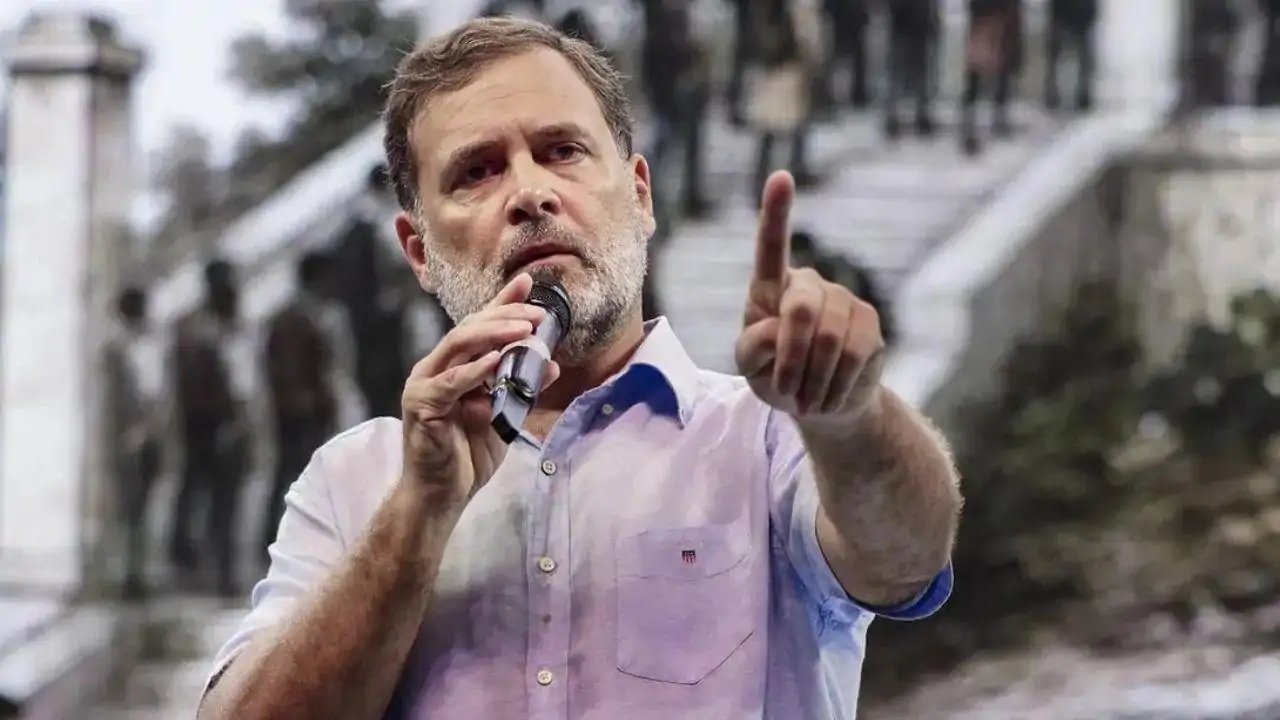
Rahul Gandhi slammed Delhi merchants for asking him to cancel the Opposition’s November 1 rally, calling their fear of economic loss a symptom of a deeper democratic crisis. The Congress leader and Lok Sabha opposition chief argued that no business is safe under the current regime, telling traders that their shops and savings remain at risk as long as he considers the electoral process compromised. He framed the issue not as logistical inconvenience but as existential threat to the integrity of the vote.
The conflict emerged after Brijesh Goyal, chairman of the Chamber of Trade and Industry (CTI), wrote to Gandhi urging the INDIA bloc to delay the gathering at Ramlila Maidan until after November 10. Goyal warned that a large-scale political mobilization near Old Delhi’s wholesale markets would disrupt festive trade worth ₹10,000 crore. He highlighted that Delhi’s markets alone generate ₹25,000 crore in turnover on Dhanteras (November 6), a critical period for gold, electronics, and automobile sales. For traders, the timing is a nightmare; for Gandhi, it is a bargaining chip.
Gandhi’s response was blunt. In a post on X, he addressed the traders directly in Hindi, acknowledging the government’s heavy-handed tactics—shutting metros and sealing roads—but pivoted immediately to the core grievance. “Tell Modi to sack accused no. 4, Gyanesh Kumar, and the protests will stop in 30 seconds,” he wrote. The reference to Kumar as “accused no. 4” underscores the INDIA bloc’s strategy of personifying the electoral controversy, framing the CEC’s handling of the Special Intensive Revision (SIR) of electoral rolls as a criminal act rather than a bureaucratic error. The Opposition alleges the Commission made unilateral decisions without the knowledge of the other two election commissioners, despite recorded objections.
This latest exchange caps weeks of escalating tension. On October 12, opposition activists marched through barricaded streets to file a Supreme Court petition challenging the SIR exercise. The following day, Gandhi hosted INDIA bloc leaders at his Delhi residence, solidifying their resolve to continue the “vote chori” (vote theft) campaign. The rally on November 1 is not just a protest; it is a political event designed to keep the pressure on the government while the festive economy gears up for its most profitable month of the year.
The government has yet to respond to Gandhi’s demand for Kumar’s dismissal, a move that would be unprecedented and legally fraught. Meanwhile, traders are left in a precarious position, caught between the political narrative of electoral fraud and the immediate economic reality of a disrupted Diwali season. The next 24 hours will determine whether the INDIA bloc stands by its November 1 date or if a back-channel negotiation yields a compromise that saves both the protest and the market.