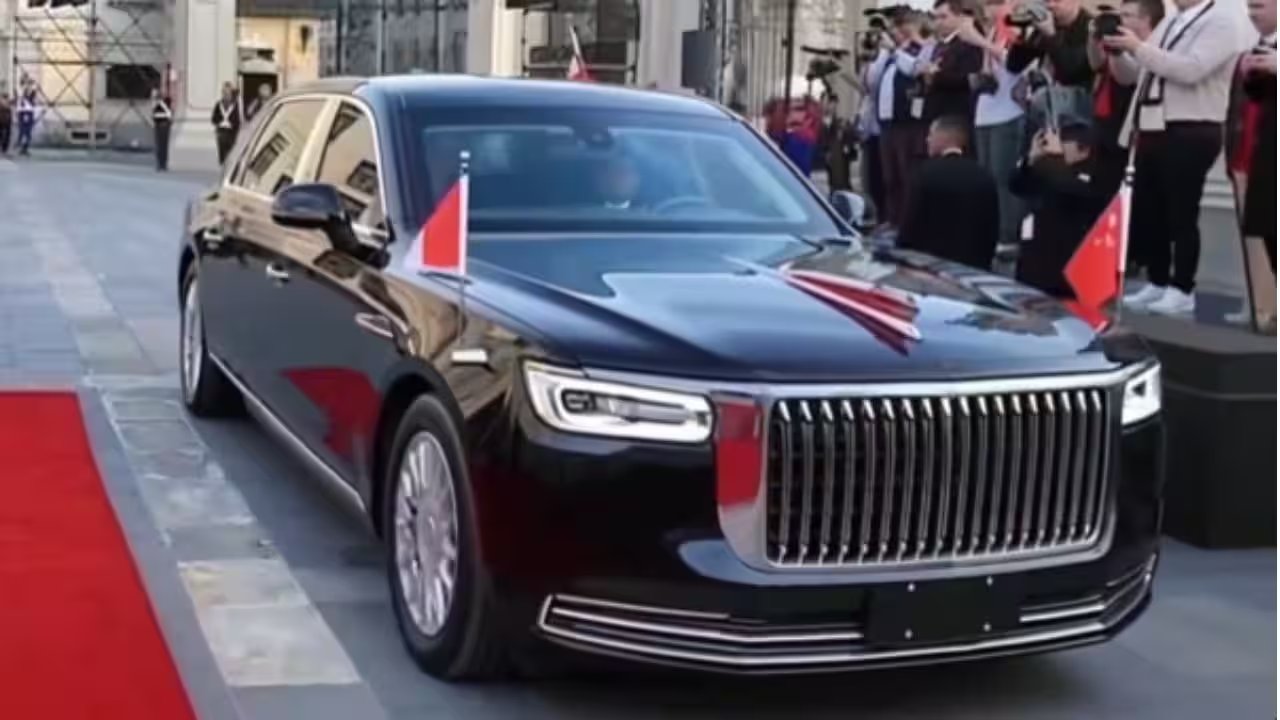
President Xi Jinping landed in Washington this week with a rolling declaration of intent: he did not leave his presidential transportation to American hospitality. Instead, Beijing flew the Hongqi N701, a custom-built, heavily armored state limousine, across the Pacific to transport its leader. The vehicle, which weighs more than three tons, features bullet-resistant glass, run-flat tires, and secure communications systems, serving as a tangible metaphor for China’s desire to operate as a global peer rather than a supplicant.
The symbolism is precise. “Hongqi” translates to Red Flag, a deliberate counter to the US “Beast,” the moniker for the American presidential limousine. For decades, visiting heads of state, including Indian leaders, relied on the host nation’s transport logistics. Xi has reversed this practice, with Chinese media reporting that Beijing now routinely flies a primary and backup car ahead of him. The N701, first seen in Hong Kong in 2022, has since traveled with Xi to Russia, France, Saudi Arabia, Vietnam, Thailand, Malaysia, South Korea, and India for the BRICS meeting.
This automotive sovereignty mirrors a broader industrial shift. The old China was a builder of American railroads; the new China is building its own highway, pulling alongside the US with its own technological ambitions and formidable industrial base. The contrast was stark during the visit, where one observer noted with wry precision that President Donald Trump appeared to touch Xi more frequently than his own wife, a behavioral detail that underscored the shift in diplomatic dynamics.
The US retains a powerful military, a global alliance network, and technical depth, but the arrival of the Hongqi N701 suggests Beijing no longer accepts the role of a guest. The vehicle is a classified asset, yet its presence is a public message: China has the capacity and the confidence to bring its own wheels to the table. The next test of this peer status will be the outcome of the trade and security talks scheduled for the remainder of the week, where both leaders must navigate their respective economic interests without further symbolic flare-ups.