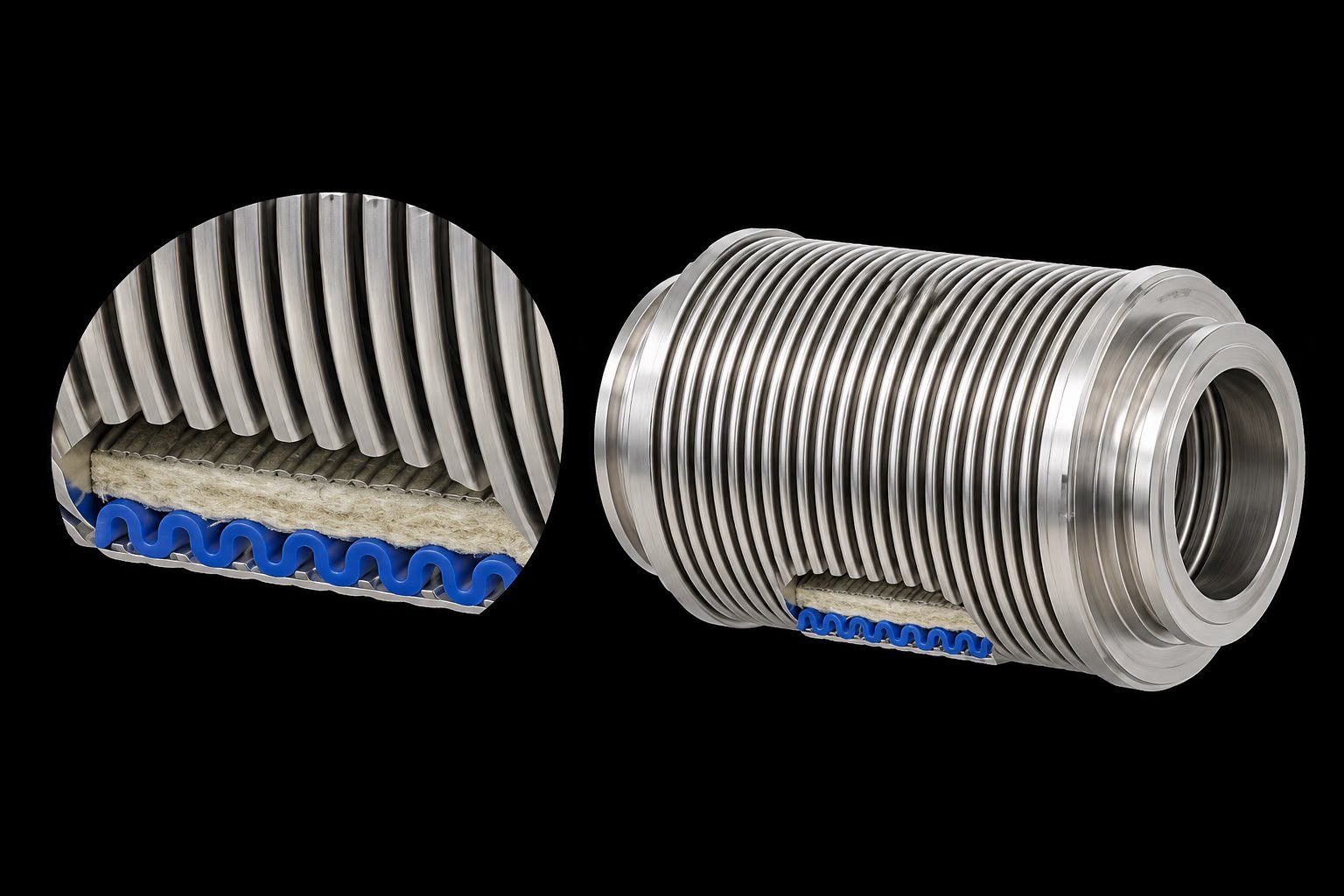
Heavy truck operators know the drill when an exhaust aftertreatment system fails. Engine twisting snaps conventional flexible joints, diesel exhaust fluid crystallises into stone-like crusts inside the pipe, and temperature drops foul the catalytic converter. Fixing it costs fleets days off the highway.
Dinex Group wants to kill that failure chain at the source. The global commercial vehicle supplier has introduced DiFlex, a flexible exhaust coupling designed to combine mechanical decoupling, gas-tight sealing, thermal insulation, and deposit defence within a single bolt-on part.
Konstantin Bondarev, Pipe Technology Solutions R&D Leader at Dinex Group, detailed the hardware during an engineering briefing. The component directly attacks the packaging compromises that have plagued commercial vehicle exhaust lines since stringent tailpipe mandates forced selective catalytic reduction (SCR) hardware onto truck chassis.
Connecting a violently vibrating heavy-duty diesel engine to an exhaust aftertreatment box requires movement. Truck makers traditionally choose between two flawed options.
They run flexible interlocked hoses or install stamped metal bellows. Neither does the whole job alone. Flexible hoses handle twisting torsional loads without snapping, yet they leak exhaust gas and bleed critical heat unless engineers wrap them in bulky, expensive external wraps. Metal bellows seal gas perfectly and flex along lateral and axial lines. But add engine twist, and bellows tear apart unless protected by complex auxiliary linkages.
DiFlex resolves this tension through a four-tier architecture. At the centre sits an inner flexible profile engineered to handle axial, lateral, and torsional movement. Wrapped directly around that core is an internal thermal insulation blanket that traps heat inside the exhaust stream. Above the insulation rests a flexible sealing membrane that maintains an absolute gas barrier even as the joint twists. Finally, a rugged outer metallic casing encases the entire assembly, shielding the functional layers from road debris and mechanical impact.
That torsional tolerance marks a decisive shift. By decoupling rotational twist without tearing the gas-sealing boundary, the joint frees chassis engineers from designing elaborate stabilizer brackets around the exhaust run.
Heat retention is not an abstract metric. In modern SCR systems, heat governs survival.
When diesel exhaust fluid (DEF) injects upstream into cooler sections of the exhaust path, the urea solution fails to vaporise cleanly. Instead, it crystallises, choking exhaust flow and throwing engine fault codes that derate vehicle speed. DiFlex tackles this by shielding the inner flexible bellows from direct exhaust turbulence while the built-in insulation retains exhaust temperatures. In comparative thermal assessments conducted by Dinex, the DiFlex coupling logged a substantially lower temperature drop than traditional reference exhaust joints.
By keeping the exhaust gasses hot immediately downstream of the dosing injector, the coupling prevents urea pooling. Crucially, the internal geometry isolates the flexible moving zones from direct dosing spray, preventing deposits from hardening within the flexing joints.
| Engineering Parameter | Dinex DiFlex Validation Benchmark |
|---|---|
| Mechanical Fatigue Test | 10,000,000 cycles at 500°C (5 Hz frequency) |
| Movement Forces Tested | Simultaneous axial, lateral, and torsional |
| Hot-Flow & DEF Dosing Test | 5,000,000 cycles over 24 hours |
| Thermal Dosing Window | 180°C to 400°C |
| Tested Exhaust Mass Flow | 100 to 400 kg/h with continuous dosing |
| Post-Validation Gas Leakage | 0 litres per minute (Zero leakage) |
Real-world commercial chassis demand varied hardware configurations. Engine bays differ drastically between cab-over city haulers and long-nose line-haul tractors.
Dinex has split the DiFlex architecture into three production formats:
Open Construction: Stripped of external shielding, this variant targets protected installation spots inside the chassis where physical road debris cannot strike the coupling.
Protected Construction: Adds an outer metallic flexible hose around the perimeter, shielding the internal sealing and thermal skins from road gravel while maintaining baseline compliance.
High-Vibration Construction: Features a reinforced outer metallic structure engineered specifically to endure severe dynamic pounding and prolonged low-frequency engine shudder.
Beyond external formats, Dinex confirmed it can tailor core insulation thickness, pipe diameter, unit length, and the geometry of the inner gas profile. These adjustments allow commercial vehicle manufacturers to match coupling dimensions directly to exact packaging pockets, target heat retention levels, and specific DEF dosing locations.
Validation data is now in hand for original equipment manufacturers and aftertreatment suppliers evaluating next-generation packaging lines. Application-specific chassis integration and durability trials will dictate adoption across upcoming commercial vehicle manufacturing runs.
| Post-Test Flexibility Force | Maintained below 150 N |
| Residual Extension Capacity | Retained 30% extension capability |