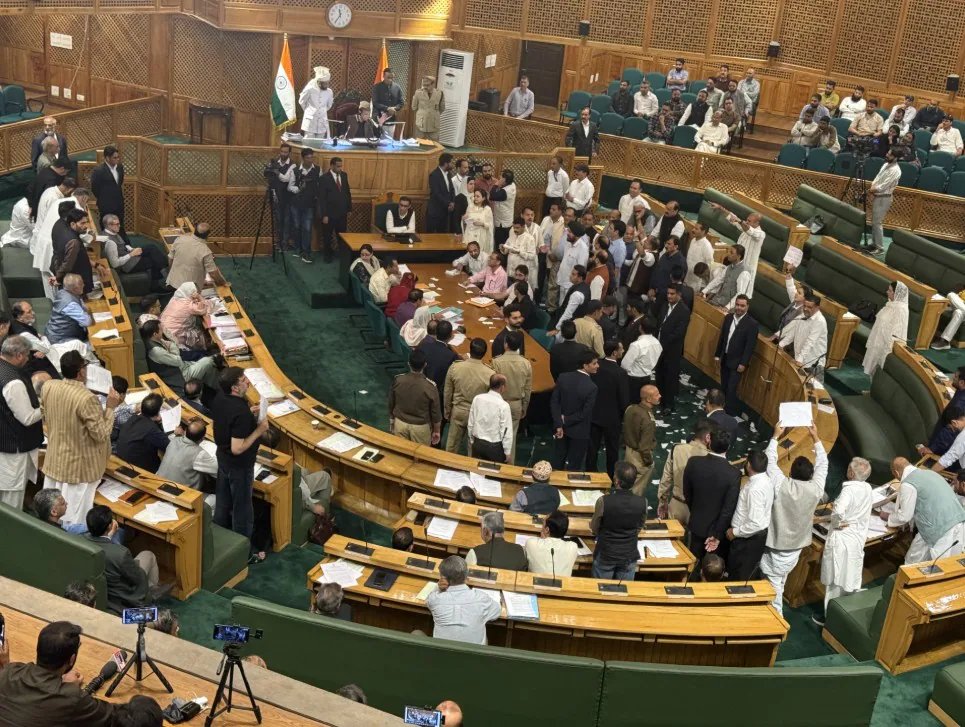
Jammu and Kashmir’s assembly descended into chaos on Friday after Chief Minister Omar Abdullah introduced a resolution demanding the immediate restoration of the state’s special status. The move triggered immediate hostility from the opposition. BJP members stormed the well of the house, shouting slogans and physically tearing up printed copies of the resolution before a scuffle broke out with ruling National Conference legislators.
The flashpoint was Abdullah’s explicit reference to two prior assembly resolutions: one from June 26, 2000, and another from November 6, 2024. The 2000 resolution called for a return to J&K’s pre-1953 constitutional position, a status where the state had its own Prime Minister and Sadre Reyasat, and was exempt from the jurisdiction of the Supreme Court and Election Commission. By citing this precedent, Abdullah framed the current demand not as a new political ask, but as a reassertion of historical rights.
After the initial pandemonium, the Speaker adjourned the house for 30 minutes. But the tension did not dissipate. When the session resumed, BJP members again surged toward the well, raising slogans that labeled the National Conference leadership “anti-national.” In response, Abdullah dismissed the accusations, stating that his party’s history of sacrifice for the nation required no validation from the BJP. “We don’t need any certificate from the BJP,” he said, adding that the resolution was about the identity of the people, not political power.
Abdullah claimed he has spent the last two years pleading with the central government for statehood restoration without success, arguing that the local BJP leadership is actively opposed to the move. He used the floor to expose what he called the “real enemies” of the people, distinguishing between those who support statehood and those who do not. The resolution, which calls on the Government of India to act “immediately and urgently,” will now face a procedural hurdle.
The assembly is expected to put the resolution to a formal vote on Monday. If passed, the document will be forwarded to the central government, setting the stage for a high-stakes constitutional and political confrontation between Srinagar and New Delhi.