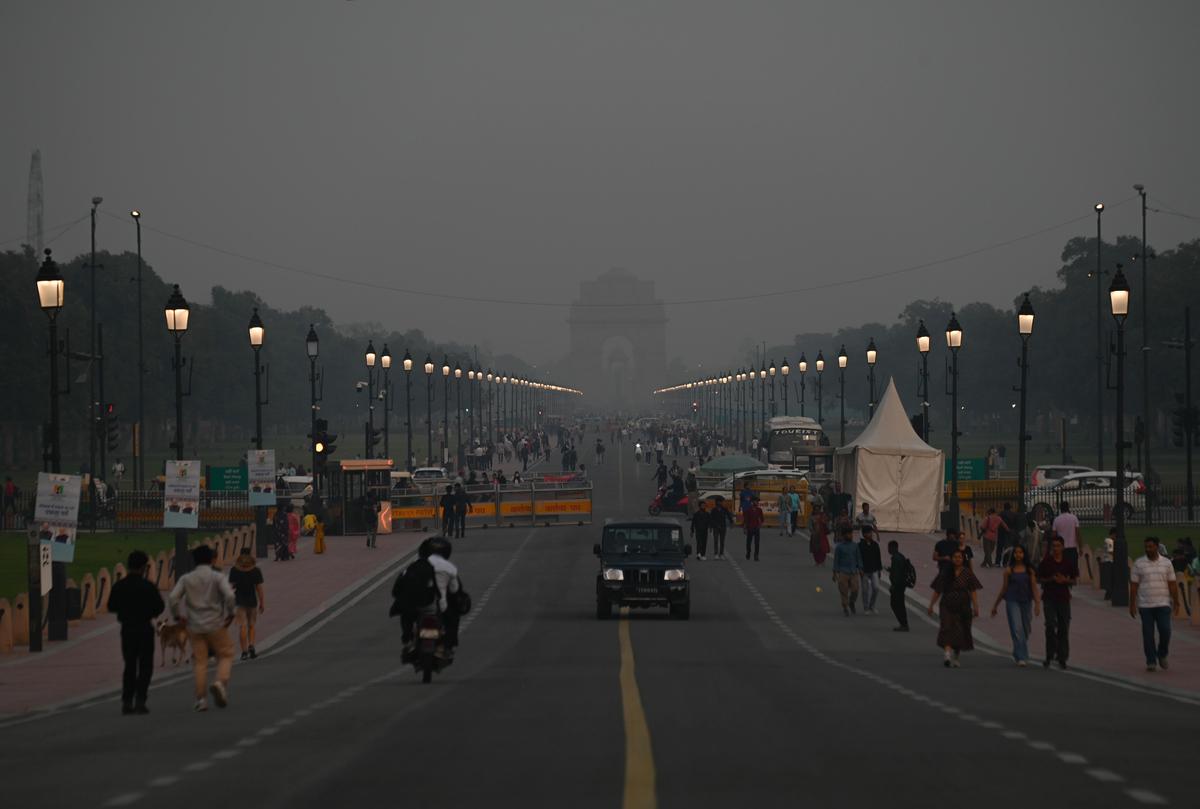
Breathing Delhi’s winter air became a guessing game this week.
Following catastrophic pollution surges during the intervening night of November 8 and 9, the Central Pollution Control Board (CPCB) confirmed on Tuesday, November 10, 2026, that it is reviewing steps to expand its particulate matter monitoring threshold beyond the existing ceiling of 1,000 micrograms per cubic metre (µg/m³). The automated system had simply cut out. When toxic smoke from rampant Deepavali firecracker bursts blanketed the capital, ambient particulate matter breached the instruments' calibrated upper limit, causing monitoring feeds to flatline for hours.
The resulting data void artificially dragged down the capital's official Air Quality Index (AQI). Residents checking government dashboards saw suppressed pollution figures precisely when airborne toxins posed the gravest threat to human lungs.
Across the capital's network of 59 air quality monitoring stations, 227 discrete PM2.5 observations went missing. At several locations, particulate levels spiked past 66 times safe thresholds established by the World Health Organization (WHO).
The technological blind spot stems from outdated analytical ceilings established when the National Air Quality Index (NAQI) first launched in 2015.
Under that protocol, automated validation algorithms treat any hourly particulate reading above 1,000 µg/m³ as an outlier error. The system purges the data entirely from the final 24-hour weighted AQI score.
The PM analysers deployed at the time of introduction of the NAQI were calibrated for a measurement range of 0
1,000 µg/m³. Accordingly, consistent with this, the designed system of automated data validation treats hourly readings beyond the calibrated range as outside range, and such readings are not used in the computation. During extreme episodes, which are occasional, like Diwali firecracker bursting, this may appear as a data gap at the particular station concerned, and those hours do not contribute to the 24-hour average of the relevant pollutant for the concerned station.”
— Central Pollution Control Board, Official Statement
Delhi’s hardware received physical upgrades over the past decade, yet administrative protocols stayed frozen. While field instruments acquired the physical capacity to track denser particulate loads, calculation rubrics remained tethered to the 2015 rules. An official confirmed that active internal consultations are now underway to lift the measurement ceiling so that peak toxic surges can be recorded.
| Air Monitoring Parameter | Baseline Metric / Regulatory Provision |
|---|---|
| Current PM Calibration Ceiling | 1,000 µg/m³ (Established under 2015 NAQI framework) |
| Missing Data Incident | 227 PM2.5 readings dropped across 59 stations |
| Delhi Station Network Distribution | 46 run by DPCC; 13 run by Central agencies |
| Minimum Pollutant Criteria for AQI | 3 pollutants required (must include either PM2.5 or PM10) |
| Peak Deepavali Surge Severity | Exceeded 66 times World Health Organization limits |
| Delhi 24-Hour Average AQI (Nov 10) | 299 (Classified as 'Poor', just below 'Very Poor' at 300) |
Accurate numbers are matter of public survival.
PM2.5 particles measure less than 2.5 micrometres across—a fraction of the width of a human hair. When inhaled, these micro-pollutants bypass the upper respiratory tract's natural filters, lodge deep inside lung tissue, and cross directly into the bloodstream. Severe exposure triggers immediate broncho-spasms, drives acute asthma flare-ups, elevates blood pressure, and magnifies heart attack risks among vulnerable demographics.
The CPCB defended its computational model by noting that the index evaluates chronic burden over instant spikes. “The NAQI recognises that prolonged exposure, rather than a momentary reading, is a more relevant indicator of ill effects on human health,” the regulatory board stated.
Yet when peak measurements disappear from baseline datasets, the rolling 24-hour averages register as misleadingly tame. High-risk heart and pulmonary patients rely on real-time AQI warnings to time outdoor errands, calibrate medication, and seal living quarters.
Of Delhi's 59 automated monitoring stations, the Delhi Pollution Control Committee (DPCC) runs 46. While DPCC monitors recorded concentrations exceeding 1,000 µg/m³ during Deepavali night, the state board does not compute independent citywide indices, leaving aggregated calculations entirely to CPCB formulas.
By Tuesday, November 10, Delhi’s overall 24-hour average AQI settled at 299, hovering on the boundary between 'poor' and 'very poor'.
Deepavali fireworks represent only one piece of the capital's environmental distress. The Supreme Court highlighted that Delhi and the National Capital Region carry the chronic, cumulative burden of vehicular traffic. The bench directed authorities to account for incoming commercial and passenger transit from neighbouring states, seeking a concrete regulatory review of interstate fleet movement.
Concurrently, the Commission for Air Quality Management (CAQM) launched a dedicated operational centre designed to pinpoint real-time emission sources across Delhi-NCR. Government officials confirmed that administrative teams are examining the technical gaps, with CPCB deliberations ongoing to recalibrate the automated calculation index before the next severe smog wave hits.