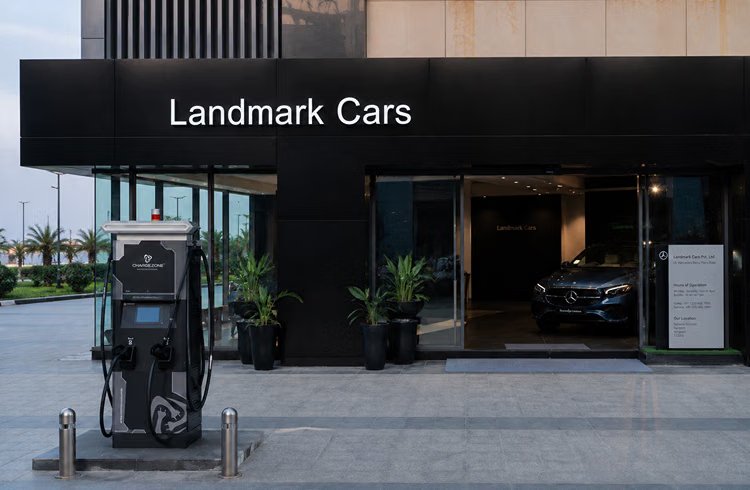
Car buyers are opening their wallets for premium metal. And premium dealerships are reaping the windfall.
Landmark Cars Ltd turned in an explosive performance for the quarter ended September 30, 2026. Consolidated net profit jumped more than twelvefold to ₹18.49 crore in the second quarter of FY2027, up from a razor-thin ₹1.50 crore during the same period last year. Revenue from operations climbed 19.9% to reach ₹1,451.61 crore, outpacing the ₹1,210.92 crore logged twelve months prior. Total expenses expanded 17.6% over the same stretch.
The profit line tells a striking story. Profit before exceptional items and tax leaped to ₹25.02 crore, blowing past the ₹60.70 lakh reported in the second quarter of FY2026. Basic earnings per share rallied to ₹4.46 from ₹0.29. Sequentially, top-line revenue advanced 11.5% from the ₹1,302.36 crore posted in the June quarter, while net profit gained 27.1% from ₹14.55 crore.
A one-off expense trimmed the final tally slightly. The group booked an exceptional charge of ₹49.10 lakh after discarding immovable property during the relocation of a Mercedes-Benz workshop in Mumbai. That brought profit before tax to ₹24.53 crore. Tax expenses totaled ₹6.04 crore—reversing a tax credit of ₹89.50 lakh seen a year ago—while finance costs ticked up to ₹21.76 crore from ₹20.20 crore.
| Financial Metric (Consolidated) | Q2 FY2027 | Q2 FY2026 | Change (YoY) |
|---|---|---|---|
| Revenue from Operations | ₹1,451.61 crore | ₹1,210.92 crore | +19.9% |
| Profit Before Exceptional Items & Tax | ₹25.02 crore | ₹0.61 crore | +4,022% |
| Exceptional Items | ₹0.49 crore | Nil | N/A |
| Profit Before Tax | ₹24.53 crore | ₹0.61 crore | +3,941% |
| Net Profit | ₹18.49 crore | ₹1.50 crore | +1,133% |
| Basic EPS | ₹4.46 | ₹0.29 | +1,438% |
| Total Consolidated Debt | ₹642.83 crore | ₹498.31 crore* | +29.0% |
\As of March 31, 2026*
Showroom yards are packing heavy inventory ahead of key buying cycles.
Stock-in-trade climbed by ₹89.33 crore during the quarter, compared to ₹17.15 crore in the year-ago period and ₹34.38 crore in the first quarter. Total inventories reached ₹796.49 crore on September 30, representing an 18.4% increase from ₹672.86 crore recorded at the close of March 2026. Trade receivables also rose, touching ₹184.23 crore against ₹156.30 crore at the end of the previous fiscal year.
That stock buildup required fresh debt. Total consolidated borrowings jumped roughly 29% to ₹642.83 crore from ₹498.31 crore at the end of March. Current borrowings accounted for the bulk at ₹580.58 crore, while non-current borrowings climbed to ₹62.26 crore from ₹21.27 crore. Vehicle floor plan payables—the direct credit lines dealerships tap to park new cars on retail floors—expanded to ₹160.03 crore from ₹139.33 crore.
Cash flow felt the strain. Across the six months ended September 30, net cash used in operating activities stood at ₹16.88 crore, swinging sharply from ₹176.86 crore generated in the corresponding half of the previous year. Working capital consumed substantial liquidity: inventories absorbed ₹123.63 crore, trade receivables locked up ₹28.95 crore, and other operational assets pulled in ₹31.89 crore.
Market Context: Dealership floor plans run on rapid turns. When dealers pack inventory ahead of seasonal demand, working capital debt spikes. For prospective car buyers, heavy yard stocks create leverage: dealers sitting on high floor plan carrying costs are far more eager to close orders and negotiate trade-ins.
Commission revenue is rewriting the balance sheet.
Under Landmark's operational model with Mercedes-Benz India, transactions operate on an agency structure. Buyers book vehicles directly through the group, Mercedes-Benz India bills the customer, and Landmark pockets an agreed commission per unit. Only that commission is accounted for as company revenue, keeping the headline throughput off the dealer's balance sheet while cutting inventory risk on three-pointed star stock.
Yet the volume passing through Landmark's hands continues to surge. The total retail value of vehicles sold on Mercedes-Benz India’s behalf reached ₹529.06 crore during the September quarter, climbing 11.6% from ₹474.08 crore a year earlier and advancing from ₹454.86 crore in the first quarter.
Now, the retailer is planting capital into new retail territory. The board cleared cash investments of up to ₹25 crore each into two wholly owned subsidiaries: Landmark Luxury Retail Pvt Ltd and Landmark Automotive Pvt Ltd. The combined ₹50 crore capital infusion will close by June 30, 2027. Neither transaction alters Landmark's 100% shareholding, and neither requires external regulatory clearance.
Landmark Automotive—renamed on November 3, 2026, from its previous identity as Motorone India Pvt Ltd—is preparing to launch a new JSW Cars dealership business alongside its existing car care services. Landmark Automotive posted revenue of ₹5.72 crore (₹572.12 lakh) in FY2026, sliding 34.5% from ₹8.74 crore (₹873.92 lakh) in FY2025 and ₹5.52 crore (₹552.49 lakh) in FY2024. Landmark Luxury Retail, incorporated on August 14, 2025, to retail luxury merchandise, posted no revenue in FY2026.
Parent-level revenue shifted downward even as standalone profit expanded.
Standalone revenue from operations dropped 4.8% to ₹202.68 crore in the second quarter, down from ₹212.99 crore in the prior-year period. But standalone net profit nearly tripled to ₹21.05 crore against ₹7.23 crore, aided by a surge in standalone profit before tax to ₹26.07 crore from ₹8.98 crore. Standalone other income edged up to ₹8.85 crore from ₹8.07 crore.
Corporate restructuring is also grinding forward. The board approved the merger of Landmark Cars (East) Pvt Ltd into the parent company on May 26, 2026. The amalgamation involves zero cash outflow and issues no new shares. Final sanction remains pending before the National Company Law Tribunal.
With an investor briefing scheduled for October 21, 2026, executive management faces sharp scrutiny on inventory velocity, debt servicing across its ₹580.58 crore in short-term credit, and rollout timelines for the incoming JSW Cars retail footprint.