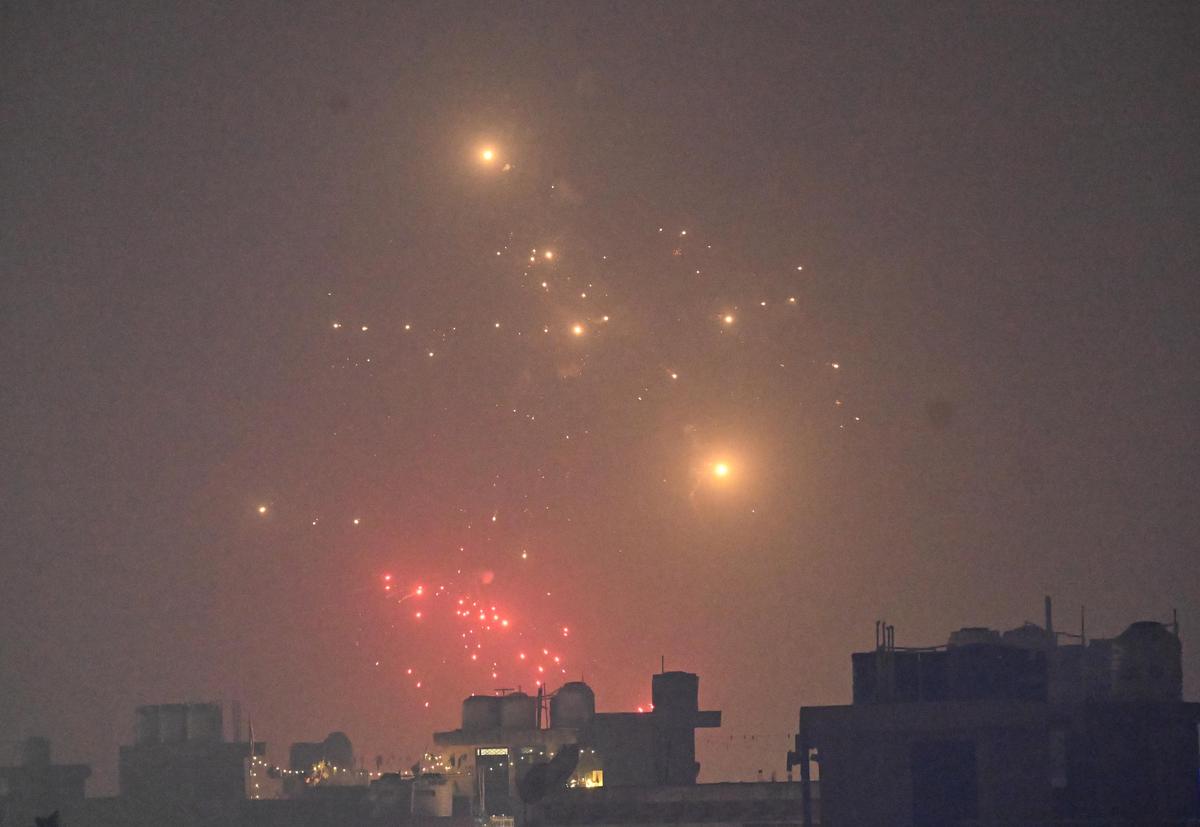
A toxic haze settled across the national capital after midnight, pushing micro-pollutant levels into territory that poses immediate physiological dangers to human tissue. Readings from the Delhi Pollution Control Committee showed fine particulate matter (PM2.5) touching an astronomical 3,008.4 micrograms per cubic metre at NSUT West Campus at 5 a.m. on Monday. That concentration is 200.5 times higher than the World Health Organisation's safe 24-hour benchmark of 15 micrograms per cubic metre. In East Delhi’s Patparganj, the concentration reached 2,597 micrograms per cubic metre—over 173 times permissible exposure.
The city gasped. While wind shifts eventually pulled the Central Pollution Control Board’s overall 24-hour Air Quality Index down to 344 by Monday afternoon, the midnight chemical onslaught exposed millions to extreme particulate loads. Traditional firecracker detonations well past court-sanctioned hours released dense clouds of sulfur compounds, carbon particulates, and heavy-metal aerosols directly into the surface breathing zone.
PM2.5 refers to microscopic airborne debris smaller than 2.5 micrometres across—roughly 30 times finer than a strand of human hair. Because nasal passages and mucosal barriers cannot filter specks that tiny, these particles travel straight into deep alveolar tissues. From there, they slip across fragile pulmonary membranes directly into the bloodstream. Once circulating, particulate matter inflames blood vessels, elevates systemic clotting risks, and strains cardiovascular output.
Short-term exposure triggers acute airway irritation, wheezing, violent coughing spells, and stinging ocular inflammation. Yet the silent vascular shock proves more concerning for clinical experts. Sustained inhalation of dense combustion smoke accelerates plaque destabilisation in cardiac arteries and forces the heart to pump against heightened vascular resistance. Asthmatic patients, senior citizens, and young children with developing lung alveoli absorb the steepest physiological toll during these concentration peaks.
“The wind direction was earlier north westerly, originating from stubble burning areas in Punjab and Haryana,” said Gufran Beig, chair professor at the National Institute of Advanced Studies and founder-director of SAFAR. “Around Sunday afternoon, it changed to easterly and south easterly and also picked up speed by Sunday evening. The reversal of wind direction led to almost negligible effect of stubble burning in Delhi.” That atmospheric acceleration dispersed the thickest blanket of smog sooner than previous post-festival episodes, averting a multi-day stagnant gas-chamber scenario.
The danger has not evaporated. Residual particulates hover close to the pavement during cool morning hours as thermal inversion traps contaminants near ground level. Pulmonologists advise city residents to avoid vigorous early-morning running, seal interior spaces against outdoor draft, and wear certified N95 respirators whenever moving through heavy traffic corridors.