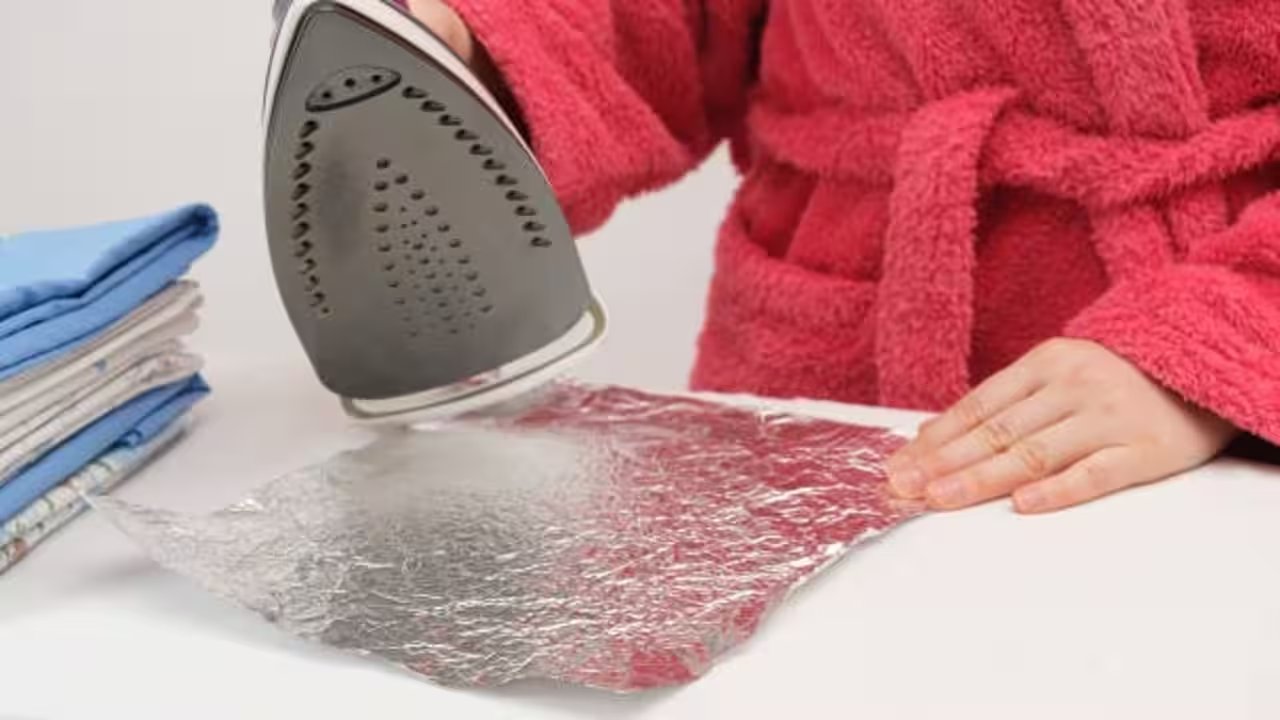
Ironing burns precious time.
You press a crisp office shirt, flip it over, smooth the collar, and watch persistent creases reappear on the reverse side. Most ironing boards let half your thermal energy escape straight into the sponge pad underneath. But slipping an ordinary sheet of kitchen aluminium foil beneath your board's fabric cover stops that heat loss immediately. It costs pocket change, sets up in 60 seconds, and turns a sluggish weekend chore into a fast, clean press.
The physics behind the trick is straightforward. Aluminium acts as an efficient thermal reflector. When your iron glides across a cotton shirt, downward heat passes through the fabric, hits the shiny foil, and rebounds back into the underside of the weave.
That upward bounce cuts your effort in half.
Instead of dragging the hot plate over the same fold three or four times, stubborn wrinkles soften and drop in just one or two passes. That speed saves real labor when tackling a tall weekly basket of children's school uniforms, linen trousers, and thick denim jeans. You spend less time flipping clothes back and forth across the board. Stiff trouser creases, pleated skirts, and heavy bedsheets yield much faster because the trapped thermal energy relaxes dense natural fibres from both sides.
| Fabric Type | Crease Challenge | Recommended Board Setting | Expected Outcome |
|---|---|---|---|
| Heavy Cotton & Linen | Deep-set, rigid wrinkles | Foil shiny-side up with steam | Creases flatten in 1 to 2 passes |
| Denim & Workwear | Thick seams, bulky folds | High heat with steady motion | Fast crease removal without repeated flips |
| Silk, Satin & Synthetics | Low melting thresholds | Standard board without foil or low dial | Eliminates risks of scorch marks or fabric sheen |
Setting up the board takes only a single kitchen roll and a pair of household scissors.
First, strip off the fabric board cover completely, exposing the base foam or felt padding. Roll out a length of standard aluminium foil that matches the entire length of the board. Lay the foil flat over the padding with the reflective, shiny side facing up toward the ceiling. Smooth out any large crinkles or air pockets with your palms—bumps left in the foil can print uneven marks directly onto light cottons under high pressure.
Trim the foil along the tapered nose of the board, leaving roughly two inches of margin. Tuck those edges tightly under the foam pad. Finally, pull your cloth cover back over the board and cinch the drawstring tight. The board should feel firm, level, and taut.
The trick comes with clear safety boundaries. Because the foil traps intense heat against the board, delicate fabrics face higher scorch risks. Silk shirts, satin blouses, polyester blends, and rubberized graphic prints can melt or warp if exposed to intense reflected heat.
Check the care tag on every garment before touching it with hot metal. Dial down your heat setting when working on delicate garments, or glide a thin cotton pressing cloth between the garment and the iron plate.
Foil also crumbles and thins over time under repeated pressure. Check the sheet every few months and replace it the moment it feels shredded or uneven. If tearing sheets of foil feels cumbersome, purpose-built heat-reflective ironing covers manufactured with woven metallic threads offer the exact same two-sided thermal rebound straight out of the box.