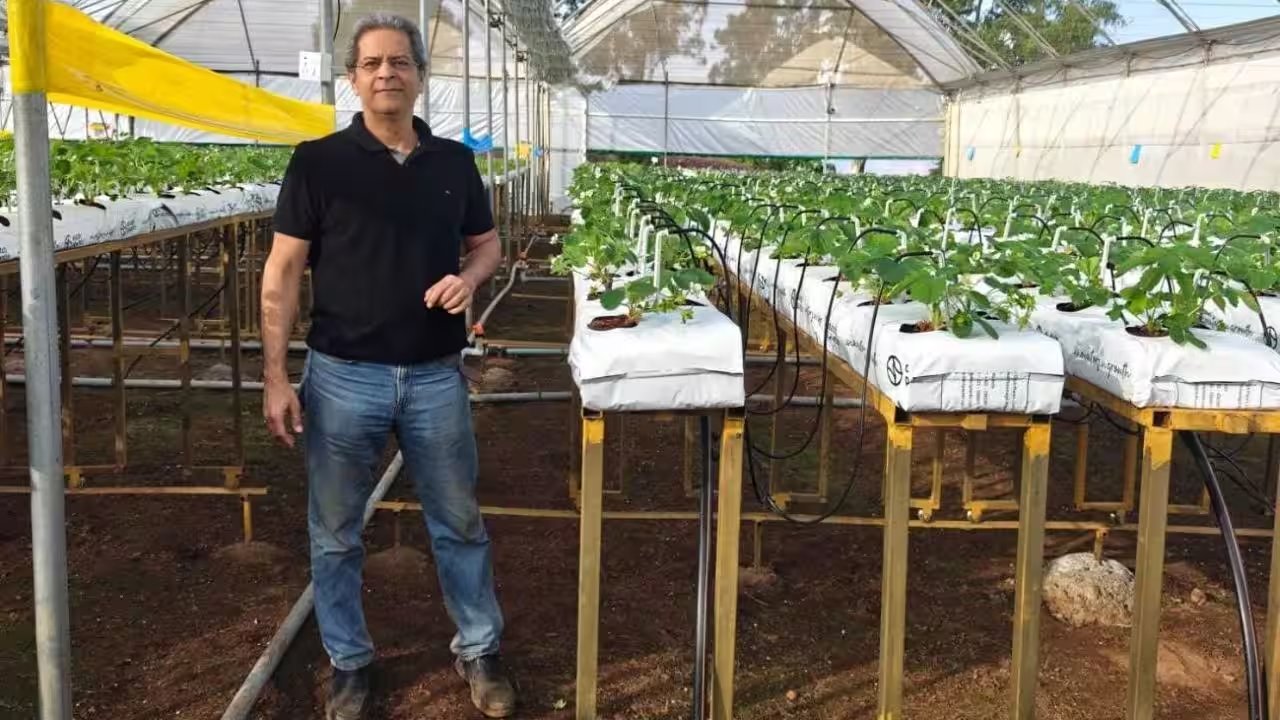
A ruined harvest breaks most beginners. Ketan Sodha doubled down instead.
Nearly a decade after his first 5,000 strawberry plants withered in Mahabaleshwar, the 57-year-old Mumbai businessman pulled off an agricultural turnaround. Between January 2024 and December 2025, his venture, Berry Fresh Agrotech LLP, harvested roughly 8,000 kilograms of strawberries, clocking ₹44 lakh in gross sales. He did it without using a single fistful of native farmland soil. Instead, Sodha grew his crop inside an automated, climate-shielded enclosure designed to defeat the very weather patterns that wreck traditional winter harvests across western Maharashtra.
Sodha, a BCom graduate from KC College who spent decades brokering agricultural land deals, knew little about horticulture when demonetisation shook his real estate firm in 2016. Seduced by Mahabaleshwar’s brisk hill climate, he bought saplings from local growers and planted them in open dirt. That maiden season flopped completely. Yet Sodha refused to pack up. He scaled to 10,000 plants in 2017, formed partnerships, and expanded his footprint across three sites covering 40 acres by the 2020-21 cycle. Then winter deluges struck. Unseasonal November rain consistently sparked fungal rot, delayed picking by three weeks, and scorched his bottom line. Open-field farming left growers helpless against erratic skies.
Between 2021 and 2022, Sodha toured commercial farms across Spain, Italy, Egypt, and Turkey while consulting hydroponics specialists from Israel, Australia, and the United States. He quickly realised foreign systems could not survive India’s brutal heat and water swings without heavy domestic modifications. So he drafted his own blueprint.
Sodha incorporated Berry Fresh Agrotech LLP in October 2022, leased two acres in Mahabaleshwar, and opened a 1,500-square-metre polyhouse in November 2024. The setup houses 19,500 strawberry plants rooted entirely in cocopeat—a sterile, moisture-retentive substrate derived from processed coconut husks. The medium insulates root systems from soil-borne fungi while automated fertigation pumps deliver 75 millilitres of water and dissolved nutrients directly to each sapling every 24 hours. A retractable roof and high-pressure misting nozzles regulate ambient moisture, while rainwater harvested on-site undergoes ozone sterilization before entering the feed lines.
Erecting the precision facility took over six months, dogged by busted valves, erratic gear, and scarce imports of specialised soilless fertilisers. Sodha and his crew mastered the plumbing and electronics themselves rather than waiting on outside technicians. That self-reliance paid off. By decoupling his crop from field mud and monsoon downpours, Sodha proved that closed-loop horticultural engineering can insulate Indian fruit production against climate chaos.