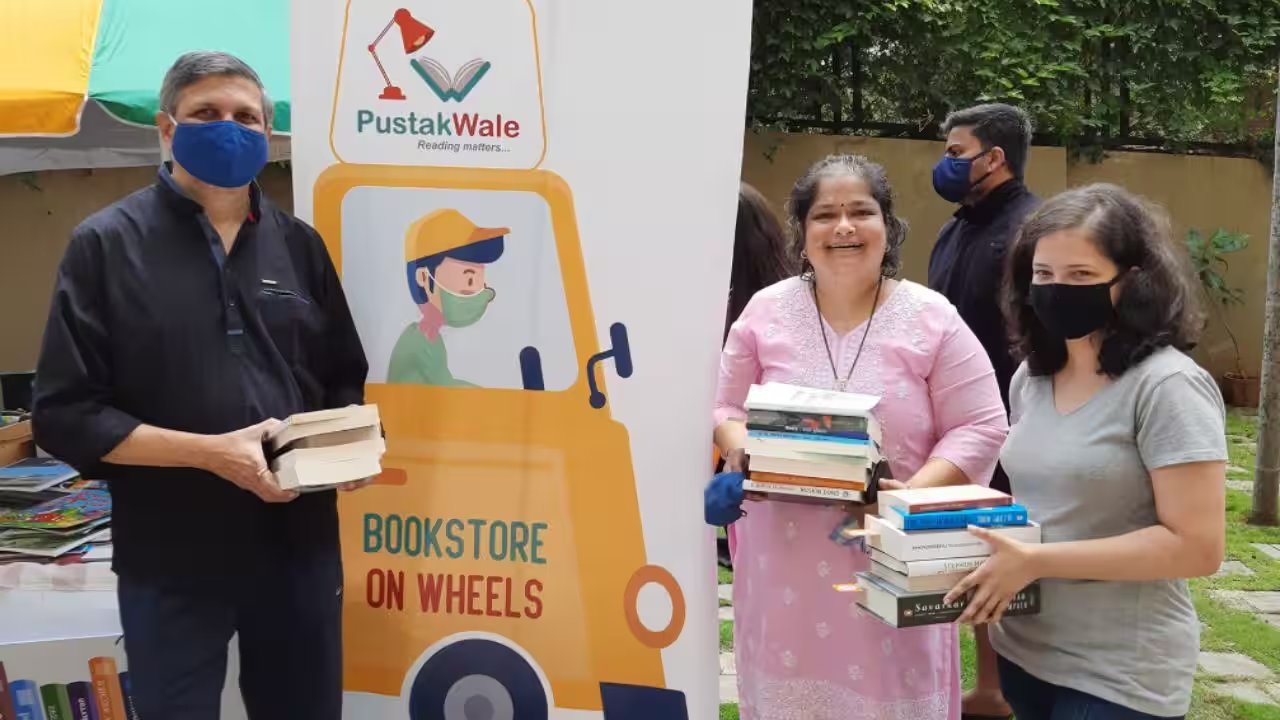
A bookstore does not need glass facades or prime high-street real estate to thrive. It just needs readers. In August 2020, Rutica Walambe, 39, and her husband Ashay Walambe, 41, packed a batch of children's titles into their car boot and set up a modest folding table inside a residential society in Baner, Pune. By sundown, half their stock was gone. Today, that impromptu weekend experiment has ballooned into Pustakwale, a doorstep book distribution engine that has moved more than one lakh physical books, reached 50,000 households, and generated over ₹1.5 crore in cumulative revenue.
The math proved what online algorithms routinely overlook: families still relish the tactile sensation of browsing. Flipping crisp pages. Comparing cover art. Handing a paperback to a child without battling screen glare or delivery delays. Pustakwale bypassed retail overheads entirely, taking titles directly to the iron gates of gated communities. Residential committees charge no stall fee; they offer the clubhouse or courtyard for free, while the founders draw earnings solely from book purchases. What began as a single housing society popup now encompasses a footprint spanning over 1,000 housing complexes, 75 schools, and 50 corporate offices across Pune.
Growth happened face-to-face, not through expensive search ads. The Walambes watched which shelves emptied first, listened to apartment chatter, and calibrated their inventory to community taste. When college students and young bibliophiles offered to pitch in, the couple created an 'Earn and Learn' initiative. More than 100 Gen Z book enthusiasts now staff exhibitions, handle sales desks, and field customer queries across Pune's sprawling suburbs.
| Milestone Metric | Verified Reach |
|---|---|
| Cumulative Books Sold | 1,00,000+ |
| Households Reached | 50,000 |
| Residential Societies | 1,000+ |
| Partner Schools | 75+ |
| Corporate Workplaces | 50+ |
| Cumulative Revenue | ₹1.5+ Crore |
| Initial Capital Raised | ₹25 Lakh (Debt) |
Instead of surrendering equity to venture capitalists early, the founders funded operations through ₹25 lakh in straight debt, raised from five backers who contributed ₹5 lakh each. Early cultural sponsorship grants from local banks cushioned logistics. That deliberate financial restraint protected ownership as volumes climbed. Now, the business is mapping a ₹50 lakh multi-stage debt raise to bolster bulk inventory, streamline operations, and support institutional contracts.
Yet moving inventory remains only the opening salvo. Ahead of Children's Day, Pustakwale is rolling out its '2 Pages A Day' campaign—an initiative crafted to persuade distracted urban families that reading two pages every evening can build an enduring daily habit. The enterprise is also formalizing paid institutional subscriptions for corporate campuses and classrooms to secure predictable, recurring income streams. Over the coming five years, the Walambes plan to extend their network of author showcases, publishers, and community libraries well beyond Pune.