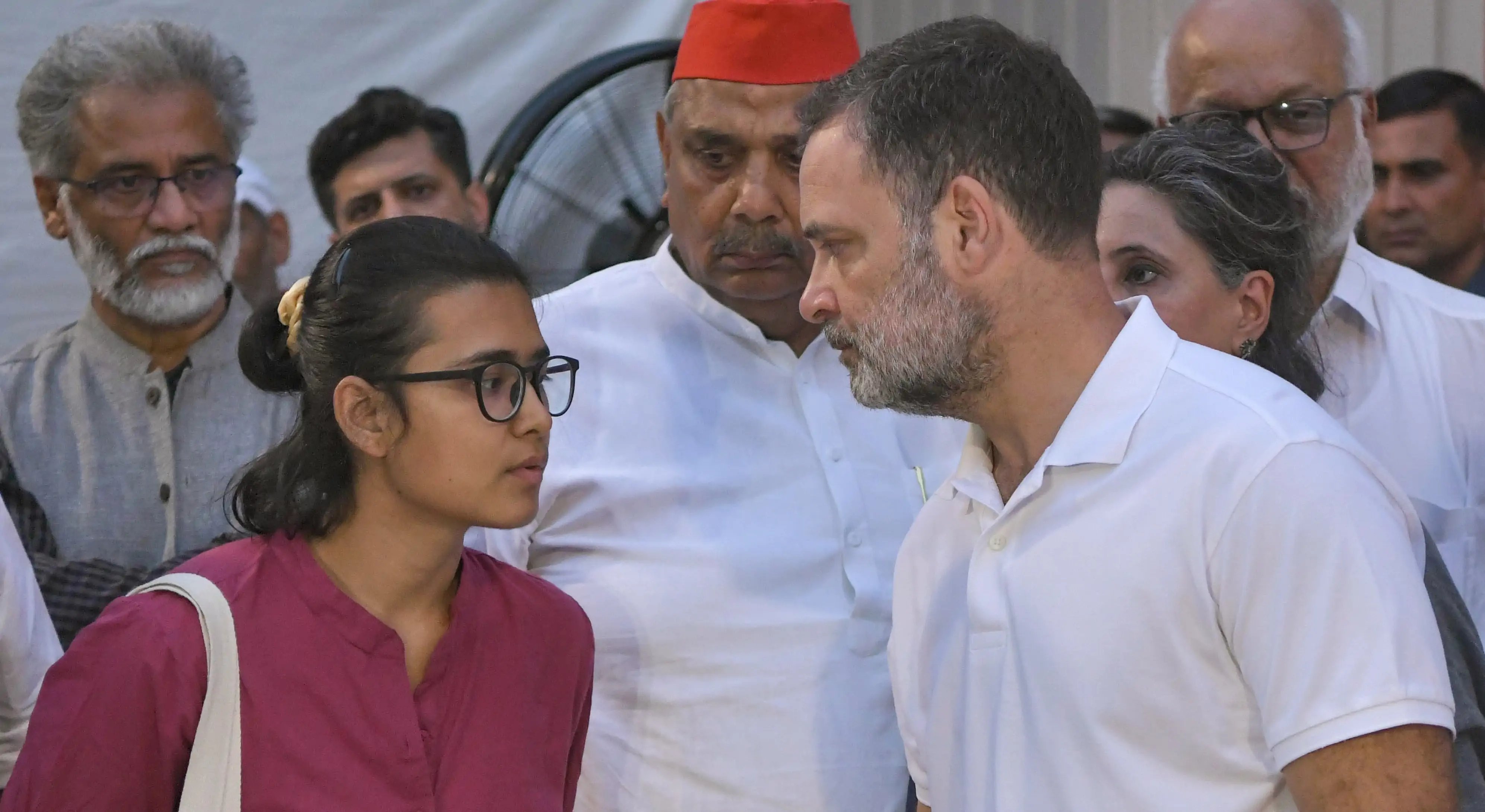
Pradeep Bhandari, a senior spokesperson for the Bharatiya Janata Party, launched a scathing attack on student activist Neha Bora on Wednesday. The exchange, unfolding on the social media platform X, quickly turned into a high-stakes political confrontation. Bhandari alleged that Bora, described by him as the poster girl for Rahul Gandhi, is motivated by a desire to orchestrate a regime change in India.
The accusation wasn't pulled out of thin air. Bhandari pointed to the recent political upheaval in Bangladesh as a blueprint, claiming Bora's actions prove that the opposition's resistance is not merely political but aimed at dismantling the current order. "The objective is regime change," he wrote, framing the student-led opposition as a threat to the established government rather than a legitimate political force.
Bora, who serves as the president of the All India Students' Association (AISA), did not back down. Speaking at a press conference following a high tea hosted by the opposition leader Rahul Gandhi, she delivered a pointed critique of the central government. She termed the BJP the singular enemy of the people, democracy, and the Constitution of India. "When we say 'We, the People versus the BJP', we are talking about one fight," she stated, emphasizing that the common man will not tolerate a compromised democracy.
Her rhetoric extended to the Election Commission of India. Bora asserted that the Commission, under Chief Election Commissioner Gyanesh Kumar, had failed in its constitutional duty. She claimed the ongoing scrutiny of voter lists was not about updating rolls but about ensuring citizens were effectively elected by the Election Commission itself, a process she labeled as treason. "The people who have facilitated this treason... need to go," she declared, a stark and direct challenge to the apex electoral body of the country.
The confrontation highlights the deepening polarization in Indian politics, where student-led movements are increasingly seen by the ruling party as vehicles for broader political destabilization. The next phase of this public spat will likely unfold in the lead-up to the upcoming general elections, with both parties expected to use this clash to mobilize their respective bases.