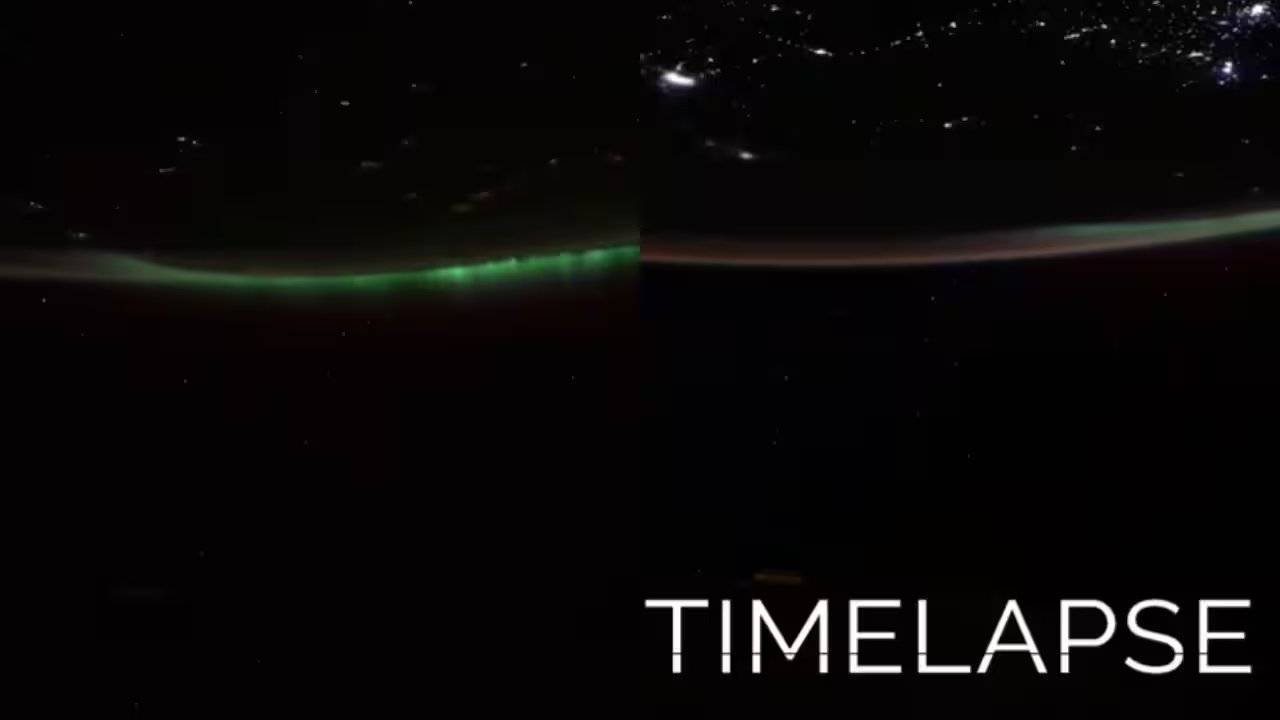
The planet crawls beneath the glass. Out the window of the International Space Station, Earth appears entirely motionless—a dark curve washed in the pale, spectral glow of an aurora. But looks deceive. NASA astronaut Anil Menon proved that by releasing two contrasting views of the exact same orbital run over the dark side of the globe. One clip ran as a compressed timelapse, whipping continents across the frame. The other ran unedited, in real time. It looked completely still. Yet the station was hurtling through low Earth orbit at roughly 17,500 miles per hour—nearly 28,000 kilometres per hour.
People fixated on the stillness. The silent video looked like a quiet, slow-motion float across empty blackness. But orbital velocity does not announce itself with engine roar or wind shear. At 28,000 kilometres per hour, the station clears the entire circumference of the planet in just an hour and a half. That means station crews witness sixteen sunrises and sixteen sunsets every single day, catching a burst of raw daylight every 90 minutes.## Velocity Behind the Silence
Menon, who posted the side-by-side clips on X, brought a distinct operational perspective to the footage. Selected in NASA's 2021 astronaut candidate class, the Indian-origin flight specialist carries Ukrainian heritage and an intense dual-track background. He is an emergency room physician and a Lieutenant Colonel in the U.S. Space Force. He earned his bachelor's degree in neurobiology at Harvard, picked up a master's in mechanical engineering from Stanford, and completed his medical doctorate specializing in trauma care before undergoing more than two years of grueling flight evaluations.
Now fully qualified for long-haul expedition tours aboard the orbiting laboratory, Menon documented how human senses warp inside the vacuum. What appears to the naked eye as a frozen celestial panorama remains an unrelenting, high-velocity transit above the atmosphere. As solar activity fuels periodic auroral displays along Earth's magnetic corridors, station crews continue their scheduled orbital operations—quietly tracking through darkness at nearly eight kilometres every second.