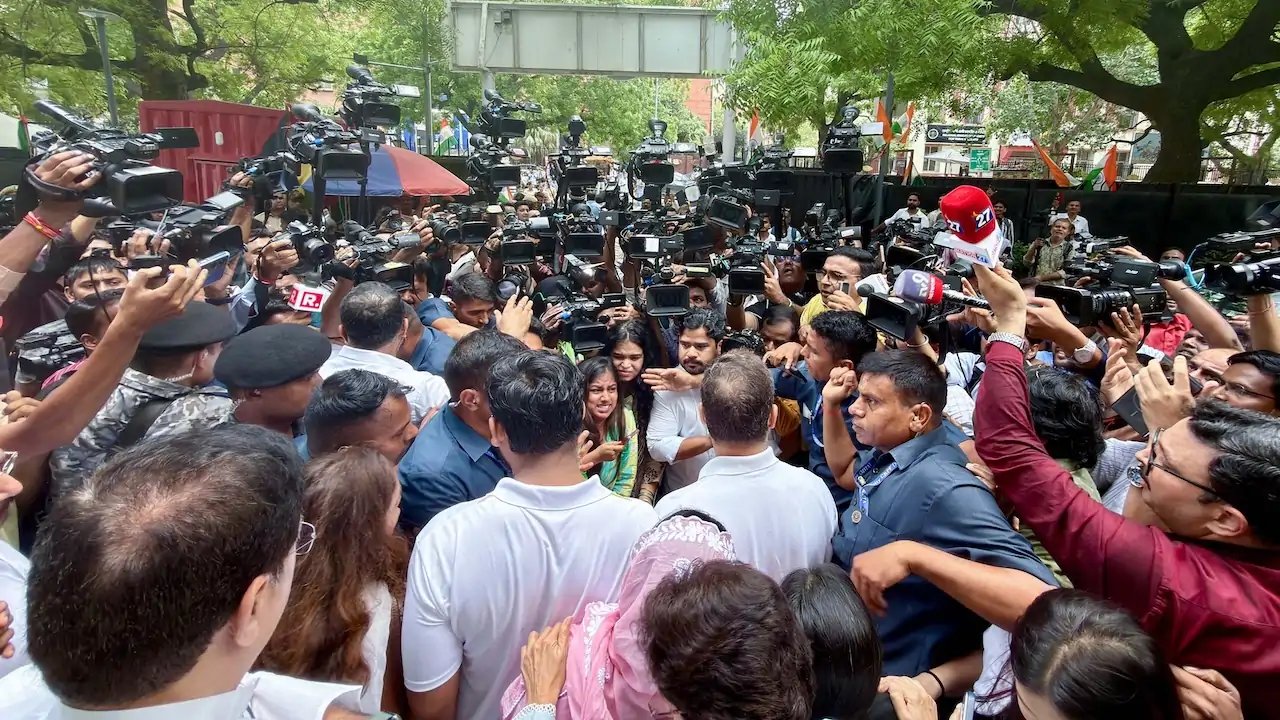
The Supreme Court on Thursday sought responses from the Centre and Delhi Police on a plea seeking national guidelines governing police interactions with journalists during protests and crowd control operations. A bench of Chief Justice Surya Kant and Justice Joymalya Bagchi intervened after senior advocate Indira Jaising argued that the lack of a clear protocol has led to the assault and mistreatment of media professionals, particularly women, during recent anti-CEC protests in Delhi.
The court’s intervention came with a specific directive regarding a woman journalist against whom a Delhi Police officer filed an FIR alleging casteist remarks and public humiliation. The bench explicitly ordered that no coercive action be taken against her. Justice Bagchi noted the allegations made by the journalist in her own complaint—claiming molestation by an officer—were "very serious" and ordered the police to examine her complaint and complete the inquiry promptly.
Jaising, appearing for the petitioner, highlighted the stark contrast between domestic treatment and global standards, stating, "Even in war zones in Israel and Palestine, journalists go there and nobody stops them. Here, they are stopping journalists from going to Jantar Mantar." She urged the court to constitute an independent committee, preferably composed of retired judges or IPS officers, to investigate complaints from women journalists, arguing that the police cannot investigate themselves. She promised to submit a list of complaints in a sealed cover.
Solicitor General Tushar Mehta pushed back on the premise of a universal definition of journalism, telling the bench, "The difficulty is that, in the present era of digital technology, anyone having a mobile is a journalist." He argued that many individuals claiming to be freelance journalists were actually "reel-makers" and that the state struggled to distinguish between genuine reporting and content creation. The bench, however, remained focused on the constitutional rights at stake, with the plea seeking a declaration that arbitrary detention and assault against bona fide news gathering violate Articles 14, 19(1)(a), 19(1)(d), and 21 of the Constitution.
In a separate but related development, senior advocate Gaurav Bhatia urged the bench to take cognisance of an incident where Congress leader Rahul Gandhi allegedly pushed a three-months-pregnant journalist in the Supreme Court precincts during an October 12 march. The bench asked Bhatia to file a separate petition on this matter, indicating it would consider the issue alongside the broader guidelines plea. The court will now await written responses from the Centre and Delhi Police before deciding on the next steps for the proposed independent committee.