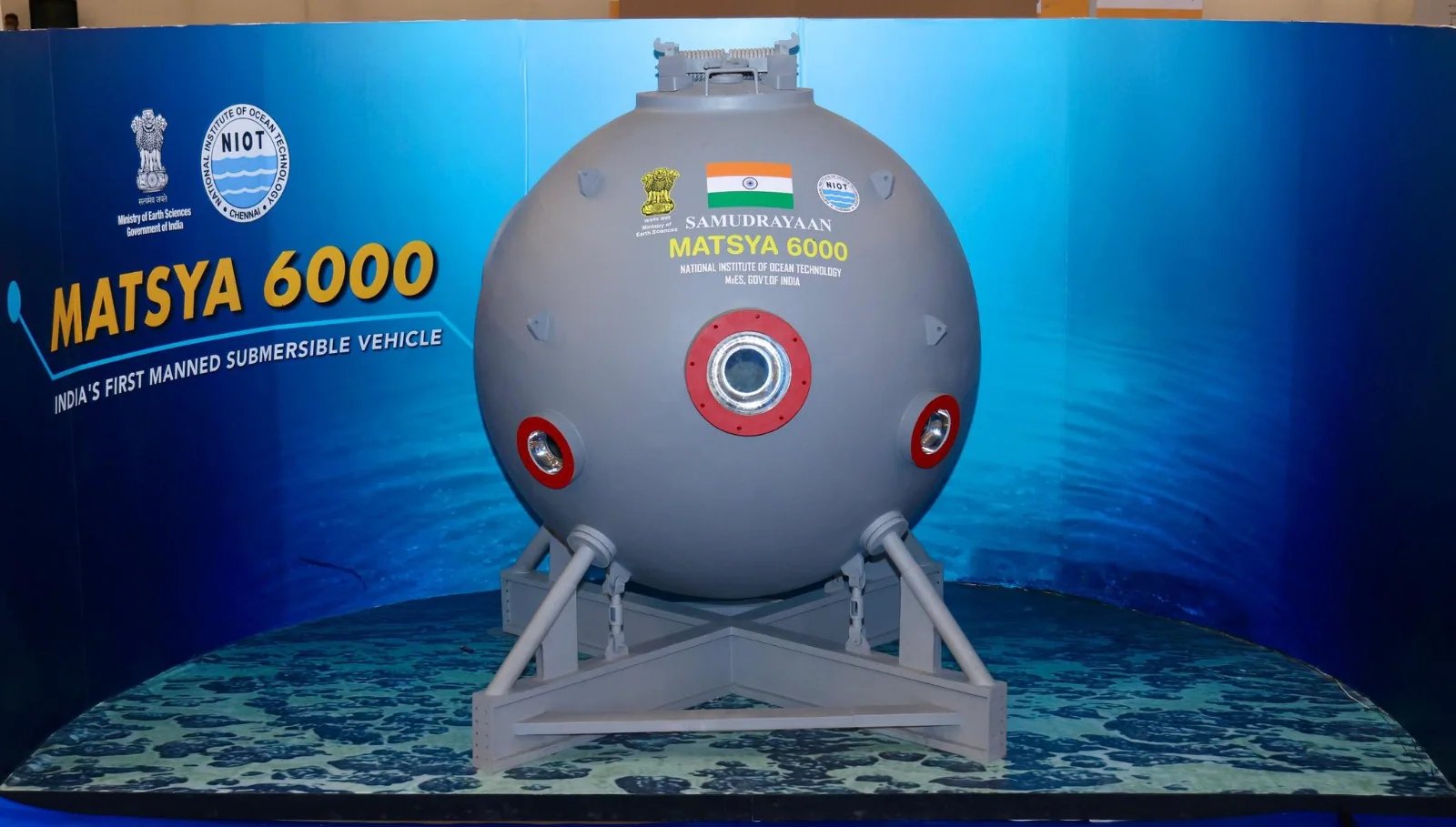
Kattupalli — India moved a step closer to the ocean abyss on Friday after its deep-submergence vehicle, MATSYA-6000, completed unmanned dockside trials off the Tamil Nadu coast. The milestone clears the Ministry of Earth Sciences to push into deep-water sea trials. The goal is audacious. By 2028, the National Institute of Ocean Technology (NIOT) plans to drop three aquanauts 6,000 metres beneath the surface into pitch-black waters where external pressures reach 600 times sea-level force.
The test at Kattupalli validated critical flotation, ballast, and power controls. At terminal operating depth, sunlight vanishes within the first 200 metres, ocean temperatures hover near freezing, and hydrostatic force exerts several hundred kilograms on every square centimetre of hull space. No margin exists for failure. A pinhole fissure at that depth implodes a vessel instantly. If the crewed dive succeeds, India will enter an exclusive club of nations — including the United States, Russia, China, France, and Japan — possessing operational human platforms rated for abyssal depths.
Chennai-based NIOT built the craft around a 2.26-metre titanium-alloy personnel sphere developed with structural engineering input from the Indian Space Research Organisation. The chamber houses three crew members alongside instrument clusters, navigation suites, and emergency breathing apparatus. The metal shell measures 80 millimetres thick. It must absorb 600 bar of punishing hydrostatic compression without flexing.
| Vehicle Specification | Engineering Parameter | Operational Standard |
|---|---|---|
| Operational Depth | 6,000 metres | Abyssal zone rating |
| Passenger Hull | 2.26 m diameter | 80 mm titanium alloy |
| Crew Capacity | 3 aquanauts | Atmospheric pressure cabin |
| Mission Endurance | 12 hours | Normal scientific run |
| Emergency Life Support | Up to 96 hours | Independent auxiliary backup |
Subsea navigation, battery packs, acoustic link modules, and fail-safe ballast releases round out the platform. Standard missions will run for 12 hours. Yet engineers integrated secondary oxygen banks and carbon-dioxide scrubbers rated for 96 hours to sustain the crew should underwater entanglements trap the vessel.
But this expedition is not just about setting maritime depth records. Commercial and strategic stakes drive the project. The target seabed across the Central Indian Ocean Basin holds massive fields of polymetallic nodules — dense, potato-shaped lumps enriched with manganese, copper, nickel, and cobalt. These minerals supply essential inputs for clean-energy storage, high-performance alloys, and battery gigafactories. As regional rivalries sharpen over critical mineral supply chains, direct deep-sea harvesting assets offer self-reliance on seabed minerals.
Biological discovery forms the secondary mandate. Deep abyssal tracts harbor chemosynthetic life clusters that thrive around scorching hydrothermal vents without solar energy. NIOT scientists plan to collect samples directly using robotic arms mounted to the craft's outer frame. The platform builds upon earlier subsea mining trials conducted in 2021, when an integrated seabed crawler tested mobility and power feeds at a depth of 5,270 metres. Deep-water wet trials in the open ocean will begin over the coming year to clear MATSYA-6000 for human certification by 2028.