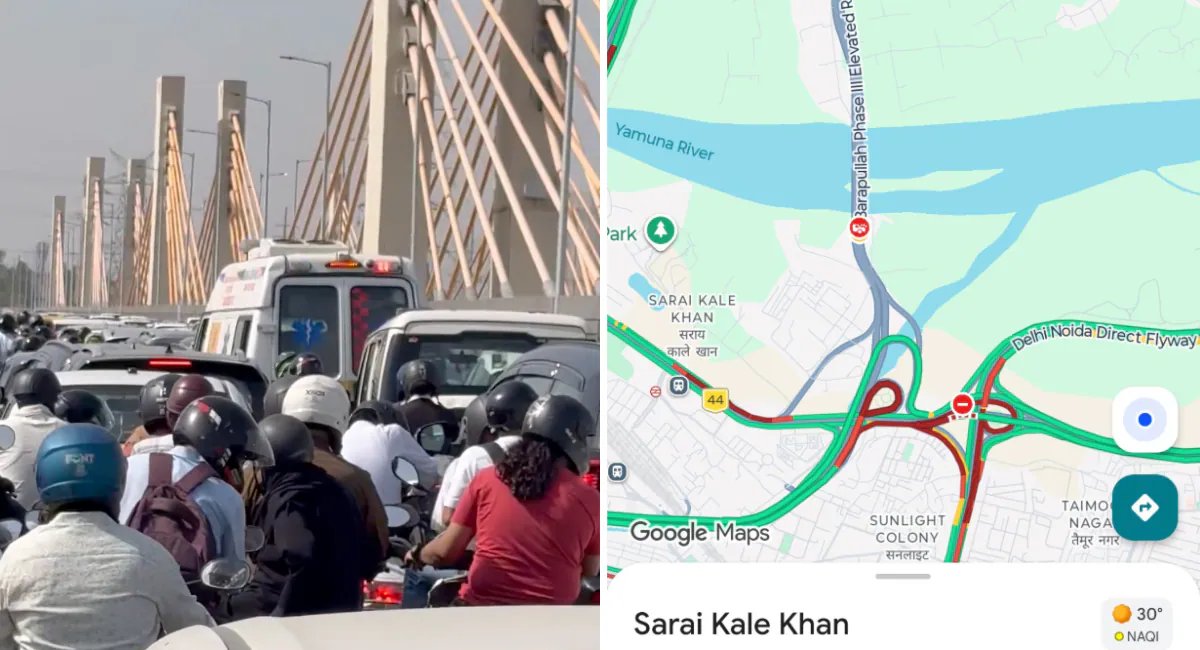
The Barapullah Phase‑3 flyover, commissioned to slash travel times between Mayur Vihar and South Delhi, opened on September 29 with the promise of cutting a 35‑40‑minute trip to roughly 15 minutes.
The new corridor was designed to give commuters a signal‑free link to Sarai Kale Khan and on to AIIMS, easing pressure on the DND Flyway, Ring Road and NH‑24.
Instead, drivers are caught in an 8‑9 lane bottleneck at Sarai Kale Khan, where the expanded corridor forces traffic into a three‑lane stretch that simply cannot handle the volume. Delhi Traffic Police posted on X that “around 8‑9 lanes are converging into three,” turning the flyover into a choke point.
The situation is worsened by NHAI’s plan to merge the Delhi‑Mumbai Expressway with the Outer Ring Road at the same junction, a move that adds further demand and illustrates the Braess paradox: expanding capacity without widening the downstream bottleneck merely relocates congestion.
Commuters have taken to social media, blaming Google Maps for not reflecting the real‑time traffic, while the traffic police urged drivers to avoid the stretch and warned that the app’s routing algorithm is contributing to the gridlock.
A senior PWD official told PTI that a meeting with Delhi Traffic Police and NHAI will explore restructuring options, but no decision has been reached yet. Meanwhile, Mrs. Mehta, a resident of Mayur Vihar, spent over three hours stuck in the jam and missed her daughter’s school drop‑off.