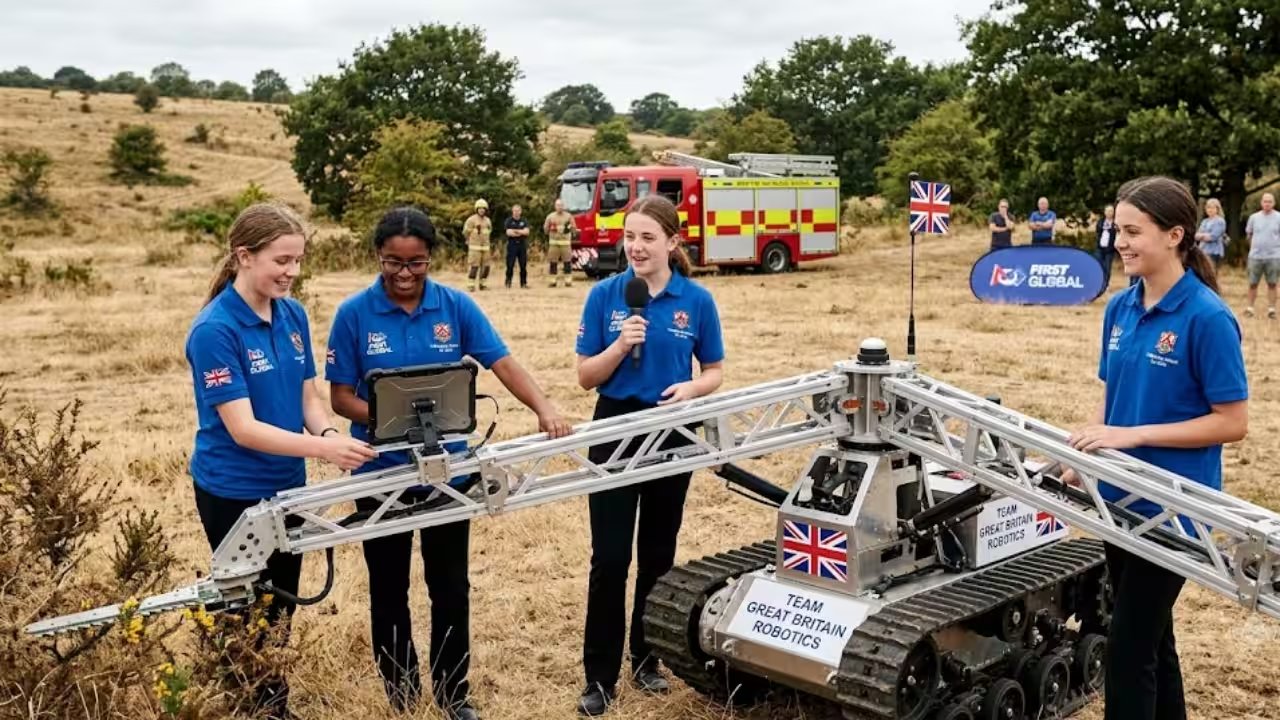
Five schoolgirls from Kent have engineered an autonomous vehicle with five-metre folding arms to create firebreaks that strip dry vegetation from wildfire paths. Team Meglabyte, drawn from The Folkestone School for Girls, built the machine to clear fuel from the ground without putting human firefighters in direct danger. The design allows the robot to cut swathes up to five metres wide through difficult terrain, removing the surface material that feeds spreading flames.
The challenge for the team was building a machine stable enough for uneven ground while keeping the weight low. Students spoke with the Kent Fire and Rescue Service early in the project to understand how wildfires behave in the field. Firefighters advised them on how flames move across rough landscapes, which pushed the team to focus on a lightweight, stable chassis that can extend its arms without tipping.
The robot runs on autonomous driving software built from standard parts provided by the competition organizers. The system allows the machine to navigate obstacles, clear debris, and operate in thick smoke where remote control would be impossible. The students spent months refining the software to ensure the arms could fold and deploy reliably under real-world conditions.
The robotics club at The Folkestone School for Girls was only founded in 2024. Despite having less experience than many international competitors, the team won the national selection process and secured Great Britain's single slot for the FIRST Global Challenge. They are now running a crowdfunding campaign to cover travel costs to Incheon and materials needed for final build adjustments.
The competition will take place in Incheon, South Korea, where students from more than 190 countries will test their solutions for preventing and recovering from wildfires. This year's theme focuses on adapting to a warming world where fire risks are rising. The students also plan to use their platform to run coding outreach programs for primary schools.
The team will arrive in Incheon to face the global challenge head-on. Their goal extends beyond winning a trophy; they want to show that a state school in Kent can produce engineering solutions for one of the planet's most urgent environmental problems.