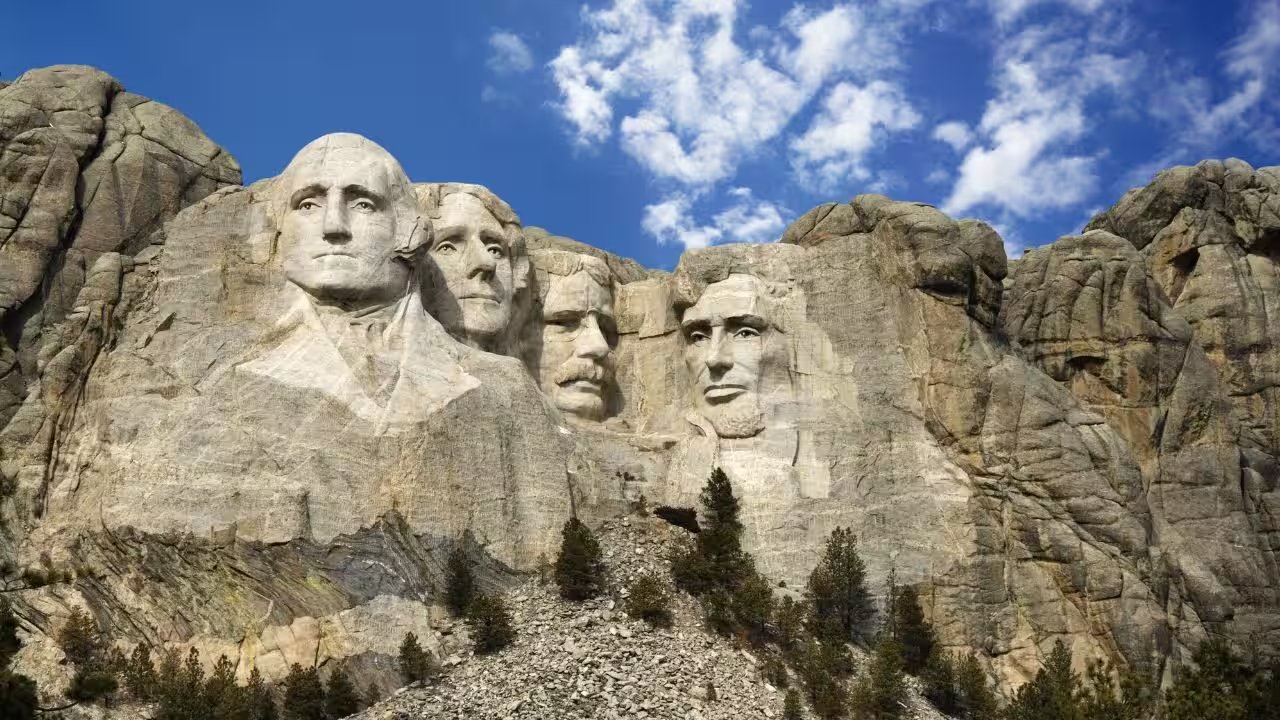
Mount Rushmore was never supposed to end at the collarbones. Sculptor Gutzon Borglum sketched four sprawling presidential figures emerging from the granite of South Dakota’s Black Hills down to their waists—complete with shoulders, suits, and carved stone hands. That vision stopped dead on October 31, 1941. After 14 years of blasting rock and exhausting $989,992 in federal and private funds, the project ran out of money. The monumental bodies vanished from the blueprints. What remains today across the pine canopy of Pennington County is an accidental compromise: four floating heads perched 5,725 feet above sea level.
South Dakota state historian Doane Robinson first pitched the massive carving in 1923 to lure motorists into the remote Black Hills. Robinson recruited Borglum, a tempestuous and ambitious artisan who insisted on sculpting figures of national stature rather than regional folk heroes. Senator Peter Norbeck and Congressman William Williamson then pushed dual authorization bills through both the United States Congress and the South Dakota Legislature. Crews struck the rock face in 1927. Borglum assigned distinct historical mandates to his chosen quartet: George Washington stood for the founding, Thomas Jefferson for the Declaration of Independence, Theodore Roosevelt for industrial expansion, and Abraham Lincoln for preserving the union during the Civil War.
More than 400 workers hauled drills and winches up the cliffs across more than a decade. They ignited dynamite charges to blast away hundreds of thousands of tons of dead stone before sculptors smoothed the features with jackhammers and hand wedges. Yet cash flow dried up constantly. Harsh winters froze the rock faces, while federal purse-strings tightened inside Washington. Borglum also began carving an ambitious Hall of Records deep into the canyon wall behind the faces, intended to house America’s founding charters. Congress balked. Lawmakers demanded that all remaining dollars target the main sculpture alone, forcing crews to abandon the records chamber in 1939.
Tragedy and geopolitical crisis delivered the final blows. Borglum died in March 1941, leaving his son Lincoln Borglum to supervise the final scraping of the rock faces. But the looming entry of the United States into World War II redirected federal resources away from civilian monuments toward industrial rearmament. Allocated accounts sat bone-dry. Rather than leave the site formally contested, federal officials declared the memorial complete at the end of October 1941.
Behind the carved facade lies an unresolved historical wound. The Black Hills remain sacred ground to the Lakota and allied Indigenous nations, who hold the peaks as spiritual territory seized through violated treaties and westward expansion. That friction endures alongside the monument's patriotic profile, complicating how visitors view the cliff face. For travellers making the journey today, Rapid City Regional Airport sits 23 miles to the northeast. Entry to the memorial grounds remains free, though visitors must navigate the Avenue of Flags and the Presidential Trail to glimpse where the granite bodies were meant to drop into the pine valley.