Baby yellow anacondas do not simply slither when predators strike. They launch.
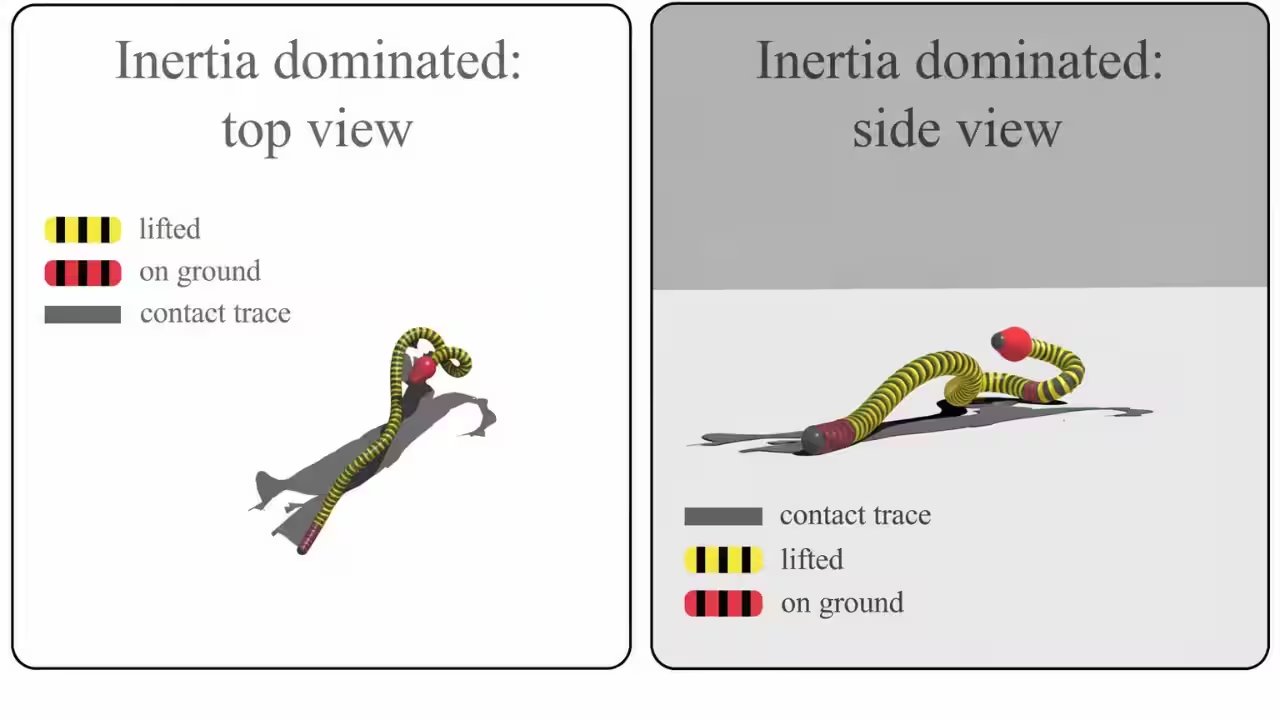
Folding into tight S-shaped coils, the young reptile lifts segments of its body clean off the dirt, builds tension, and snaps straight like a released spring. The sudden surge drives the snake across rough ground without slipping—a feat that eludes conventional machines. Detailed in the 2025 study "Topological dynamics of rapid non-planar gaits in slithering snakes," published in Nature Physics, the biomechanical sequence offers robotics engineers an unexpected blueprint for navigating ruined, uneven terrain without limbs.
Herpetologist Bruce Young spotted the rare non-planar burst in juvenile anacondas before physicist Raghunath Chelakkot mapped the mechanics through high-speed footage and elastic computational models. When threatened, the juvenile serpent sends raised, undulating curves rippling down its spine from head to tail. By lifting bulk off the dirt, the snake slashes surface friction. Then it uncoils. The uncoiling triggers a violent forward thrust that grips the ground rather than skidding. Harvard researcher L. Mahadevan characterized the non-planar maneuver as "the serpentine analog of the moonwalk" in an analysis released by Harvard’s Materials Research Science and Engineering Center.
Growth destroys the trick. Adult yellow anacondas pack immense constricting muscle, yet their sheer mass bars them from the air. The escape sprint functions only within a razor-thin structural envelope—a strict biological Goldilocks zone. If an anaconda grows too thick and heavy, its muscular torque cannot hoist its girth off the soil. If it is too light, the burst spins out of control. Much like mid-sized frogs that achieve the longest leaps relative to scale, only juvenile snakes possess the precise ratio of weight, girth, and leverage required to launch.
To simulate the escape, researchers configured flexible elastic rods propelled by three precisely timed muscular torque pulses. When the team looped those three pulses repeatedly, the virtual rods began sidewinding—mirroring the lateral glide of desert vipers. The shift stunned investigators. While anacondas share no close evolutionary branch with desert vipers, the mechanical overlap suggests complex lateral locomotion may have sprung directly from juvenile panic reflexes. Similar structural looping appears in brown tree snakes climbing smooth electrical poles on Guam.
Such structural principles translate directly into mechanical engineering. Arnab Pal of The Institute of Mathematical Sciences in Chennai pointed out that soft robotics confronts an identical balancing act among structural stiffness, propulsion energy, and physical control. The three-pulse mathematical framework can map how earthworms burrow, how lampreys slice through currents, and how caterpillar segments crawl. Adapting those elastic equations could soon steer legless search-and-rescue machines through collapsed rubble where wheels and tracks fail.