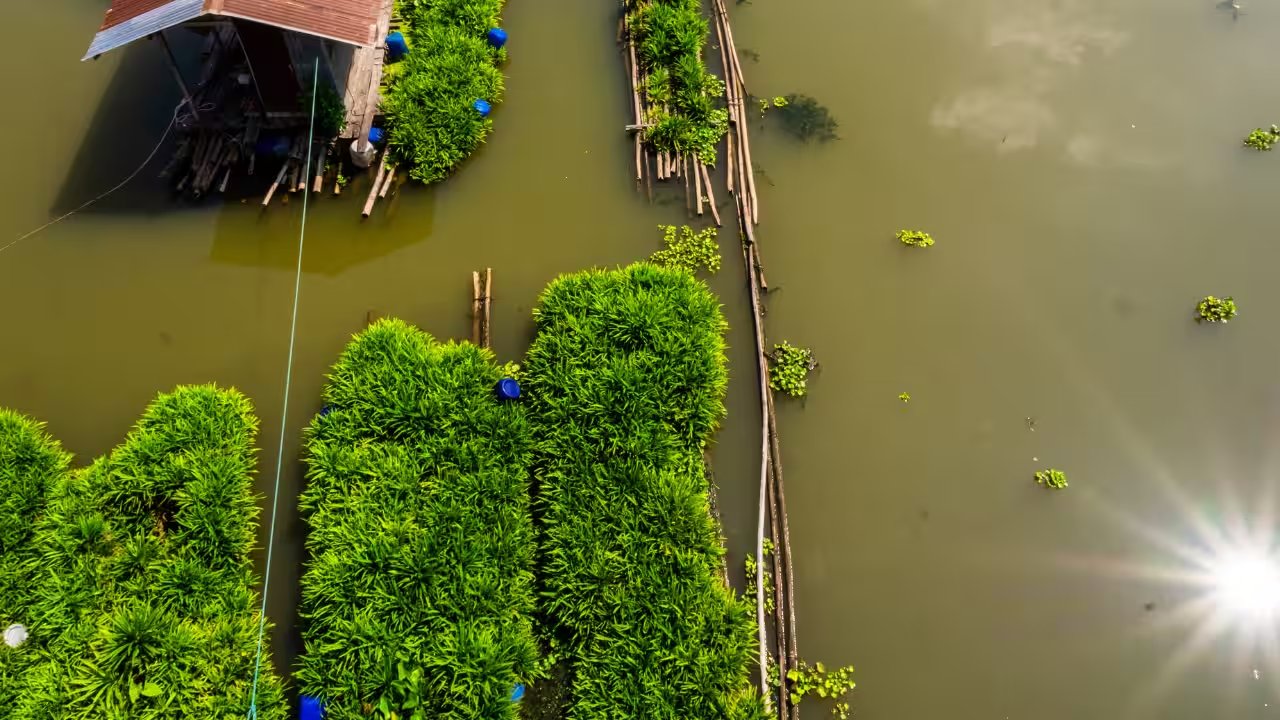
The land vanishes. For seven to eight months every year, surging rivers drown the flat southern plains of Bangladesh, turning roads into channels and wiping out conventional soil farming. Nearly 80 percent of the nation rests on a vast river delta. When seasonal rains peak, floodwaters submerge up to two-thirds of the country.
Yet local growers refuse to abandon their harvests. Instead of waiting for muddy ground to resurface, communities across Gopalganj, Barisal, and Pirojpur pull their livelihoods straight out of the water. They build buoyant, soil-free garden beds from dense weeds. The practice—known locally as dhap or baira—transforms a destructive seasonal disaster into an abundant hydroponic nursery.
Construction starts in June or July when monsoon downpours flood the riverbanks. Farmers collect sprawling tangles of water hyacinth—an aggressive, free-floating aquatic weed—and pile them into long strips over calm pools. Paddy stalks are frequently woven into the base for added structural integrity.
Growers jump onto the floating mounds, compacting the stems with their bare feet. Every eight to ten days, they haul fresh piles of weeds onto the platform to create dense, layered mats. The finished rafts stretch between eight and ten metres long and span several metres wide. Farmers finish each bed by spreading a thin top layer of garden soil and cow dung.
| Specification | Agricultural Dimension & Material |
|---|---|
| Structural Framework | Woven water hyacinth and compact paddy stalks |
| Standard Bed Dimensions | 8 to 10 metres long, several metres wide |
| Layering Frequency | Fresh weed layers added every 8 to 10 days |
| Binding & Fertilizer | Top dressing of local soil and cow dung |
| Core Vegetable Crops | Okra, ribbed gourds, spinach, and eggplant |
| Seasonal Inundation | 7 to 8 months of continuous standing water |
Nothing goes to waste. As the bottom layers of water hyacinth slowly rot in the warmth, the decomposing vegetation feeds the crop roots with steady organic nutrients. Cultivators harvest vibrant yields of okra, gourds, spinach, and purple eggplant while standing in narrow wooden canoes.
This floating system is not an untested experiment. Families in the southern wetlands have refined the craft across 300 to 400 years of trial and survival. Now, international agencies view the ancient technique as an essential blueprint for low-lying regions grappling with severe weather disruptions.
On 15 December 2015, the United Nations Food and Agriculture Organization formally designated the floating garden system of Bangladesh as a Globally Important Agricultural Heritage System—making it one of only 34 such preserved sites on Earth.
Traditional farmers can offer real solutions for food security when given proper policies and investment." > — Maria Helena Semedo, United Nations Food and Agriculture Organization
As seasonal deluges grow longer, agricultural bodies are examining whether the baira model can be introduced to other flood-prone territories across Asia and Africa. For the growers working the waters of Pirojpur and Barisal, the mission remains immediate: weave the rafts, sow the seedlings, and keep the food supply afloat.