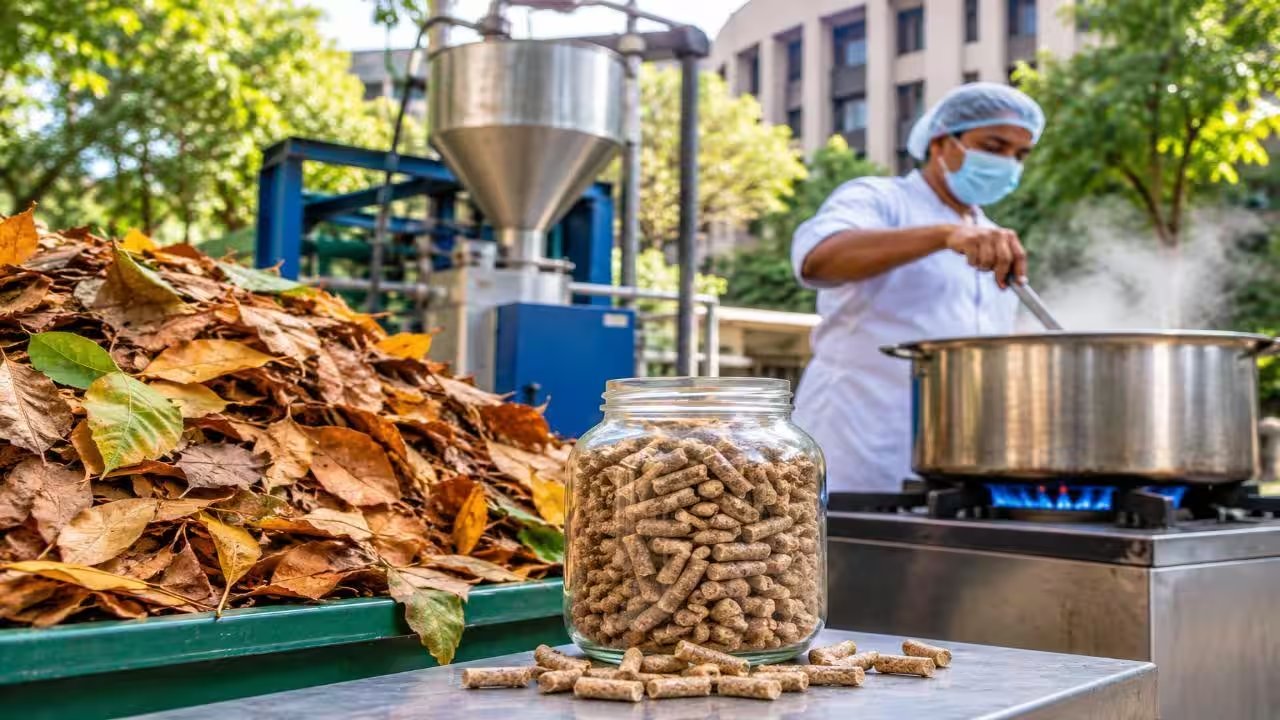
IIT Bombay has eliminated a ₹50 lakh annual disposal bill by turning two tonnes of daily garden waste into cooking gas for 1,200 students.
Swept leaves and dry twigs no longer leave the Powai campus in haulage trucks. Instead, engineers feed the organic debris directly into an on-campus pelletisation plant, convert it into synthetic gas, and fire the steam boilers in Hostel 16. The shift has slashed the student kitchen's liquefied petroleum gas consumption by 60%.
The initiative rests on a custom closed-loop engineering setup documented in the 2024-25 annual report of the institute's Research Hub for Green Energy and Sustainability. Campus maintenance teams rake up nearly two tonnes of biomass every day across the 500-acre site. Rather than trucking this organic matter to suburban dumping grounds, crews feed the fallen leaves, trimmed foliage, and twigs into a dedicated pelletisation unit capable of processing two tonnes per shift.
The compressed pellets yield an energy density of 16 to 18 megajoules per normal cubic metre. But burning raw pellets directly in a high-density kitchen produces heavy smoke. To circumvent this, the researchers route the fuel through an in-house-developed downdraft gasifier. The reactor converts the solid pellets into clean producer gas—a flammable mixture of carbon monoxide, hydrogen, and methane—which feeds directly into a premix burner to generate high-pressure steam for cooking cauldrons.
| Parameter | Specification / Metric | System Benefit |
|---|---|---|
| Daily Waste Generation | 2 tonnes/day | Diverted entirely from municipal landfills |
| Pellet Plant Capacity | 2 tonnes per shift per day | Matches full campus organic output |
| Fuel Calorific Value | 16–18 MJ/Nm³ | Replaces fossil-fuel gas cylinders |
| Initial Canteen Saving | 10 kg LPG per day | Proved thermal reliability during 30-day trial |
| Hostel 16 Cooking Scope | 1,200 resident students | Feeds multi-pot steam cooking units |
| Kitchen LPG Displacement | 60% net reduction |
The operational breakthrough took over a decade of trial and redesign. In 2014, Professor Sanjay Mahajani from the Department of Chemical Engineering began experimenting with small-scale gasification units to handle campus plant litter. The earliest prototypes hit an immediate physical roadblock: clinker formation. Ash, silica, and mineral salts in Indian biomass melted under high combustion heat, fusing into glass-like slag that choked the reactor grates. Smoke quickly spilled into test kitchens.
The team resolved the bottleneck in 2016 by patenting a modified gasifier geometry that suppressed clinker deposition by nearly 100 times. A year later, Professor Sandeep Kumar from the Department of Energy Science and Engineering joined the project, redesigning the burner interface to stabilize flame temperatures under changing fuel moisture levels.
With development backing from the Tata Centre for Technology and Design, the team launched a full operational test at the campus staff canteen on February 26, 2025. Over the following month, data loggers tracked a steady reduction of 10 kilograms of commercial LPG every single day.
To move the technology beyond internal demonstration kitchens, IIT Bombay licensed the patented system to Infixen Energy, a university-incubated startup tasked with deploying commercial units. Following the 60% fuel displacement recorded in Hostel 16, project coordinators plan to link the remaining campus dining halls to the pellet supply line, fully offsetting institutional cooking fuel purchases while locking in the institute's ₹50 lakh annual transport savings.
| Drops operating fuel bills significantly |
| Annual Haulage Avoidance | ₹50 lakh per year | Eradicates off-campus trucking overhead |