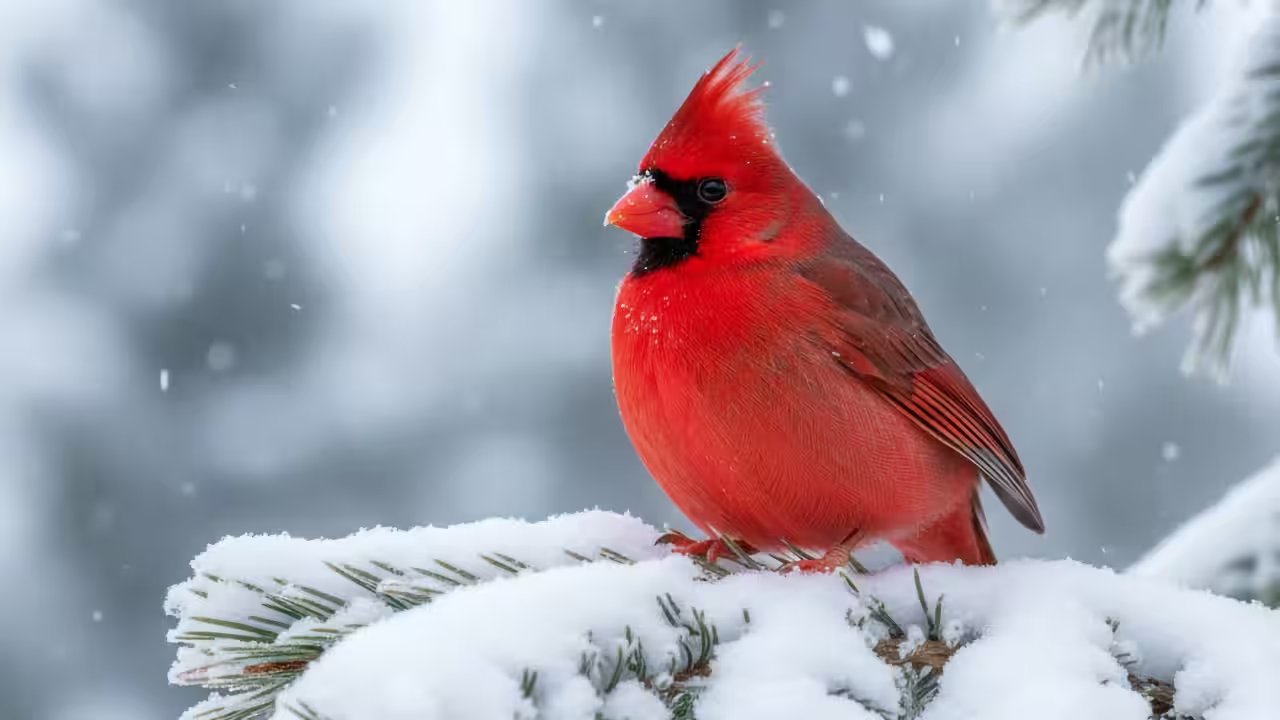
A bare tree branch under a freezing night sky looks like a death sentence. Yet across sub-zero winter landscapes, tiny songbirds wake up every morning chirping. Cold kills, and frozen birds routinely turn up inside nest boxes after bitter cold snaps. Surviving those dark hours comes down to sheer mechanical efficiency. Research led by Olav Hogstad, professor emeritus at the NTNU University Museum in Norway, reveals that small birds rely on radical physiological shifts and emergency communal tactics to make it to daybreak.
Small birds lose core body heat fast. Their surface area is massive compared to their light frame, and their bodies cannot store deep layers of insulating blubber. If they bleed warmth overnight, they die. Survival hinges entirely on heat retention during nights that stretch between 18 and 19 hours. That defensive battle begins before twilight settles across the forest.
Snow is not an enemy—it is a thermal blanket. Heavy grouse species—including the wood grouse, black grouse, hazel grouse, and willow ptarmigan—routinely dive into deep drifts to carve insulated snow caves. Trapped inside those subterranean pockets, temperatures stay far warmer than on exposed branches swept by biting winds. Tiny birds adopt the exact same architecture. The 13-centimeter mealy redpoll carves an entire network of snow tunnels during deep freezes, ducking beneath the powder and tunneling sideways to lock out the wind.
But what happens when snow is scarce? Birds pool their heat. Eurasian wrens abandon their solitary routines to cluster into dense feathered balls—with observers documenting as many as 60 wrens packed inside a single England roost. Treecreepers jam themselves into narrow bark fissures, setting aside their vicious territorial instincts because freezing alone means certain death. Other species face brutal turf wars. Great tits do not possess the beak strength of woodpeckers to hollow out wood, so they scrap aggressively over existing tree cavities before dusk falls.
Camping through the freeze requires relentless fuel. Long-tailed tits and willow tits must pack on roughly 10 percent of their entire body weight during daylight hours just to produce enough shivering warmth to clear an 18-hour night. That turns every minute of weak winter sun into a high-stakes foraging rush—because when darkness arrives, that 10 percent cushion is all that stands between them and the frost.