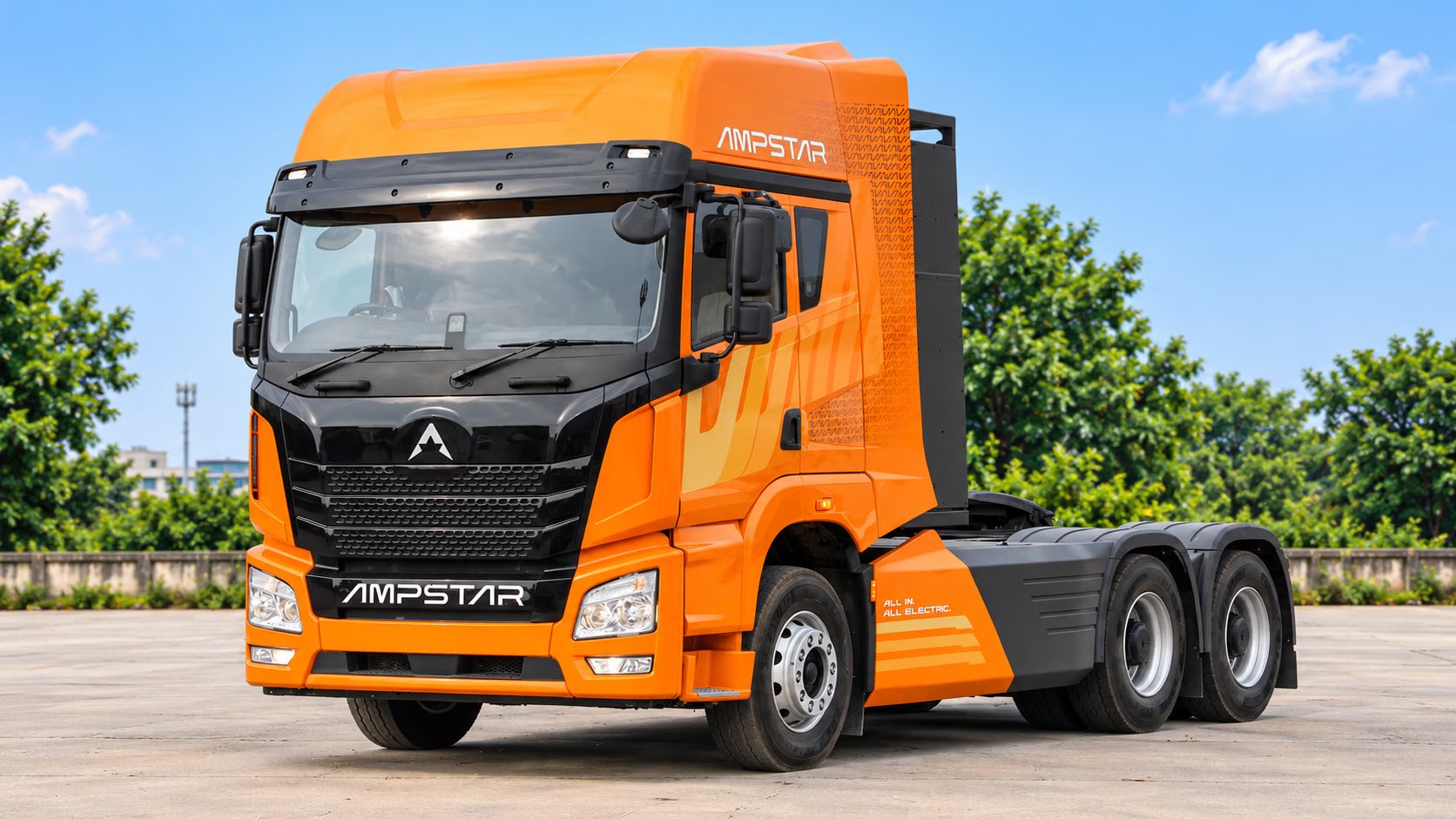
If you’re eyeing a 55‑tonne electric tractor‑truck for industrial haulage, the recent 100‑unit order from JSW Cement signals a turning point. It shows that large‑payload electric trucks are moving beyond concept into real‑world freight.
The Ampstar 55T pushes the envelope with a 430 kW peak power output and 2,600 Nm of torque. It rides on a 4×2 chassis, designed to haul clinker and slag across a 330‑km corridor between Nandyal and Vijayanagar. JSW Eco‑Mobility will supply a battery‑as‑a‑service model, setting up four swapping stations along the route to keep the trucks running for a monthly haul of about 125,000 tonnes.
In the electric heavy‑haul arena, the Ampstar sits in the same league as Volvo’s VNR Electric (≈350 kW) and Daimler’s T2 (≈400 kW). While diesel counterparts—Kenworth T680, Volvo VNR, Caterpillar 797F—offer similar payloads, the electric models trade off range for lower emissions. Ampstar’s 55‑tonne class is one of the largest in the market, making it a serious contender for bulk‑material transport.
The trucks received Central Motor Vehicle Rules certification from the Automotive Research Association of India, a first for an all‑electric 55‑tonne tractor. This approval, coupled with the Battery‑as‑a‑Service partnership, aligns with the government’s push for 30% of freight transport to be electric by 2030. It also shows that the regulatory hurdle for heavy‑electric vehicles is being lowered.
The 100‑unit fleet will be built at JSW Greentech’s 90‑acre greenfield site in Chhatrapati Sambhajinagar, a facility slated to churn out 15,000 electric buses and trucks annually. Once operational, the plant could scale up production for other industrial clients, potentially bringing the Ampstar 55T to market in the next 12–18 months. Buyers should keep an eye on how the battery‑swapping model performs in real‑world freight and whether the company expands its charging network across India.