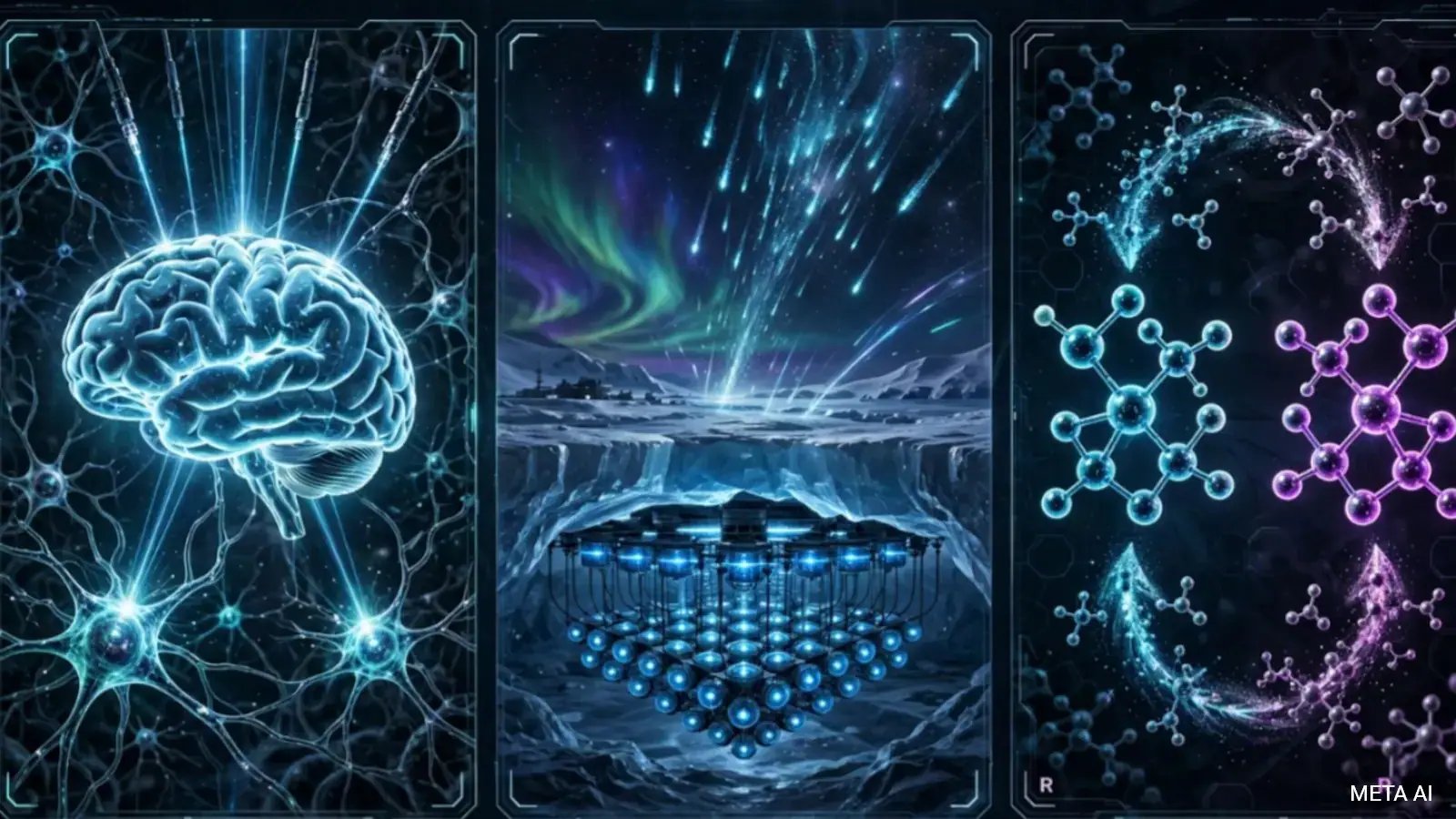
Francis Halzen claimed the 2026 Nobel Prize in Physics for his decisive contributions to the IceCube Neutrino Observatory. The detector, buried in the South Pole ice, catches high-energy neutrinos—ghostly particles that zip through the universe without interacting with matter. Halzen realized in the 1980s that these elusive particles could reveal the secrets of the most powerful objects in the cosmos. Construction began in 2004 and finished in 2011. Two years later, the observatory logged 28 high-energy cosmic neutrinos. The Royal Swedish Academy of Sciences cited his work on the discovery of high-energy neutrinos of astrophysical origin.
Karl Deisseroth, Peter Hegemann, and Georg Nagel took the Nobel Prize in Physiology or Medicine for pioneering optogenetics. Their research allows scientists to control brain cells using light. The breakthrough started in the 1990s when Hegemann noticed that single-celled algae called Chlamydomonas reacted to light faster than the human eye. He suspected a special protein was responsible. With Nagel, he identified two genes producing light-sensitive proteins. Deisseroth adapted this mechanism for neurons, the electrical signal carriers in the brain. When exposed to light, these modified neurons fire and pass signals to neighbors. Researchers now use this technique to study depression, schizophrenia, dementia, anxiety, and addiction. They are also exploring its potential to restore vision in specific types of blindness.
Henri Kagan of the University of Paris-Saclay and Kenso Soai of the Tokyo University of Science earned the Chemistry Nobel for their work on chirality. Chirality describes molecules that are mirror images but cannot be superimposed, much like left and right hands. Amino acids in proteins are generally left-handed, while sugars in living organisms are right-handed. Kagan proved in 1986 that chemical reactions could amplify the difference between these two forms beyond expectations. Soai pushed the boundary further in a 2003 study. He demonstrated that a tiny imbalance could grow exponentially through repeated reactions. In one specific example, repeating a reaction three times increased the molecular imbalance by 630,000 times. This finding offers new pathways for understanding how biological asymmetry emerged.
The Academy announced the Physics prize on October 6, 2026, the Physiology or Medicine prize on October 5, and the Chemistry prize on October 7. Each award carries a prize money of 11 million Swedish kronor (approximately $1.1 million). The winners will receive their medals and diplomas in Stockholm in December.