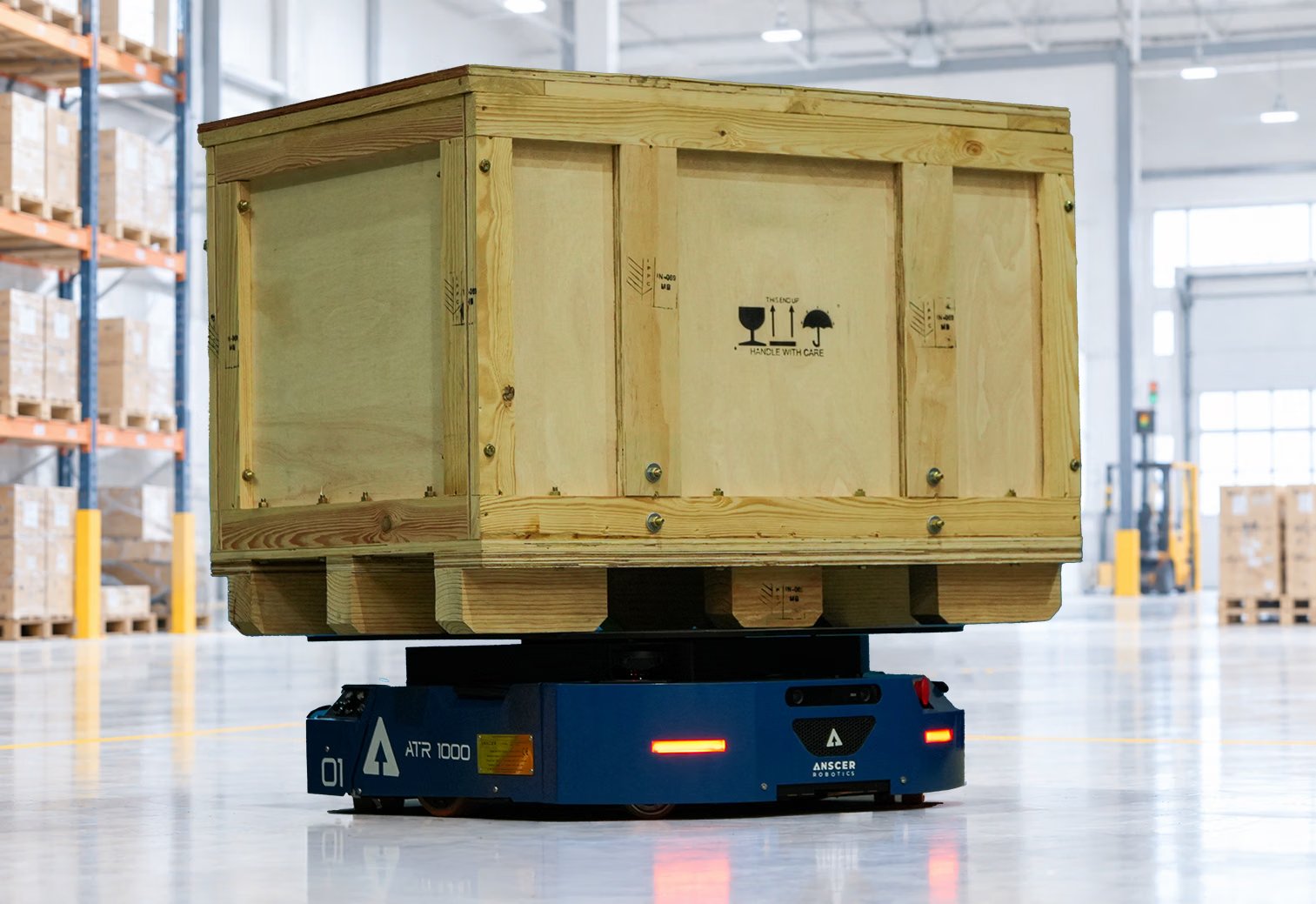
If your warehouse floor is tight, you know the headache of trying to maneuver a standard forklift without scraping a rack or waiting for a clear lane. The ATR 1000 tackles this by shrinking the footprint to under one square meter while still hauling a tonne of material. It’s a compact solution for facilities where space is premium, not just a marketing buzzword.
The real trick here is the integrated turntable. Most autonomous mobile robots (AMRs) just drag or lift a pallet and stop. You still need a human or a separate mechanism to rotate the load. The ATR 1000 rotates the payload 360 degrees on its own. This means angular docking—essentially plugging the robot into a workstation at any angle—and multi-face access, so you can grab components from different sides without moving the heavy base. It kills the manual reorientation step, which is often the bottleneck in lean manufacturing.
Navigation is handled via SLAM (Simultaneous Localization and Mapping), allowing it to operate without floor markers or tracks. If you prefer a more rigid path, QR-code navigation is available as an option. It moves at 1.5 meters per second—fast enough for continuous flow, but slow enough to be safe around personnel. Safety is covered by 360-degree LiDAR, which creates adaptive zones that shrink or expand based on the robot's speed, backed by visual and audible alarms.
For buyers, the question isn't just about the robot; it's about integration. Can it dock with your existing conveyors? Does it handle the specific pallet types in your facility? With a turning diameter of just 1,020 mm, it fits in corridors that would choke a standard AGV. ANSCER is positioning this for heavy-load material movement in manufacturing and warehousing, directly targeting the gap between manual labor and rigid, track-based automation systems.