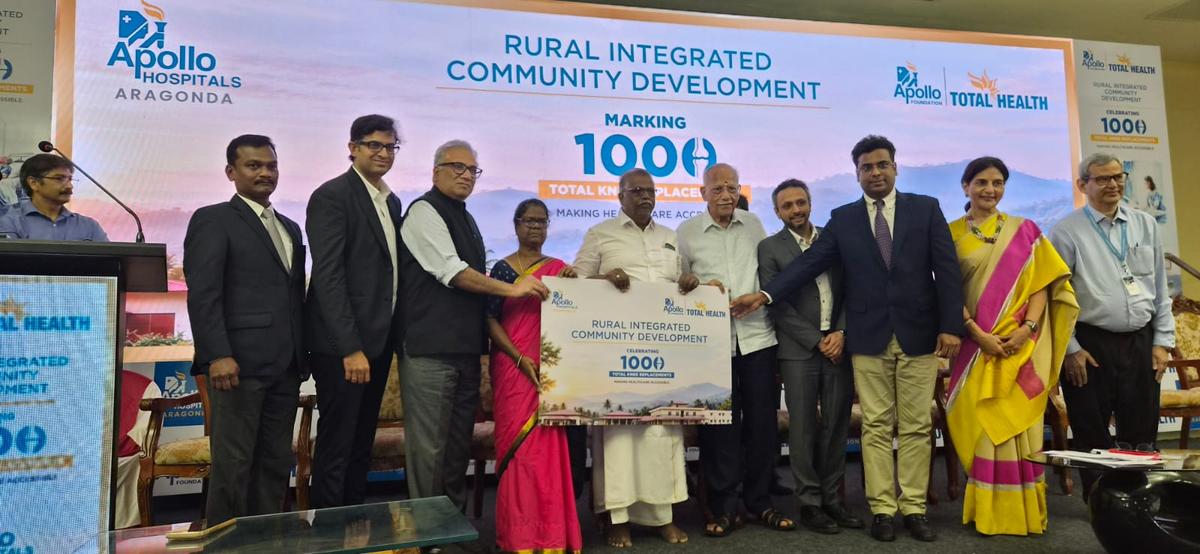
Rural healthcare in India is routinely written off as basic triage. Not in Aragonda.
Situated in Andhra Pradesh’s Chittoor district, Apollo Foundation’s 50-bed rural hospital has completed 1,000 total knee replacement surgeries without a single reported infection. The milestone marks a rare feat for a remote healthcare facility. Since opening its doors in 2000, the centre has treated more than 1.67 lakh patients and handled over 12,000 operations across 26 years of service. What began with 100 knee procedures in 2019 rose to 500 in 2022 before crossing the four-figure mark this year.
Yet surgery is only the final safety net. Under its Total Health programme, the foundation targets the daily habits and living conditions that make people sick in the first place. That strategy led to serving over 10.8 lakh balanced meals to senior citizens through geriatric nutrition centres. It also involved hosting more than two lakh guided yoga sessions, running free screenings for chronic non-communicable diseases, and delivering 1,200 antenatal and postnatal check-ups for rural mothers. Hygiene education has reached 2,600 schools, while vocational and sports training engaged over 545 young people.
“Medicine can save lives, but to change the health of a generation, we must also change the conditions in which life is lived,” said Prathap C. Reddy, founder chairman of Apollo Hospitals Group. The village is his birthplace. What started as an effort to bring modern diagnostic equipment to his ancestral home has expanded into an umbrella covering women’s financial autonomy, clean water, and adolescent wellness.
The campus also served as an early pioneer for remote medicine. Using just three telephone lines, the hospital originally connected rural desks with urban specialists, transmitting ultrasound scans and CT files across state lines so patients avoided expensive trips to metropolitan hubs. Former US President Bill Clinton reviewed a live telemedicine demonstration from the village during a diplomatic visit to Hyderabad.
Joint Managing Director Sangita Reddy noted that maintaining a zero-infection rate across 1,000 complex joint replacements proves clinical discipline need not drop outside big cities. Looking ahead, Executive Vice-Chairperson Preetha Reddy confirmed the organisation plans to use the Aragonda data to replicate similar preventive, high-speciality rural clinics in other underserved regions across India.