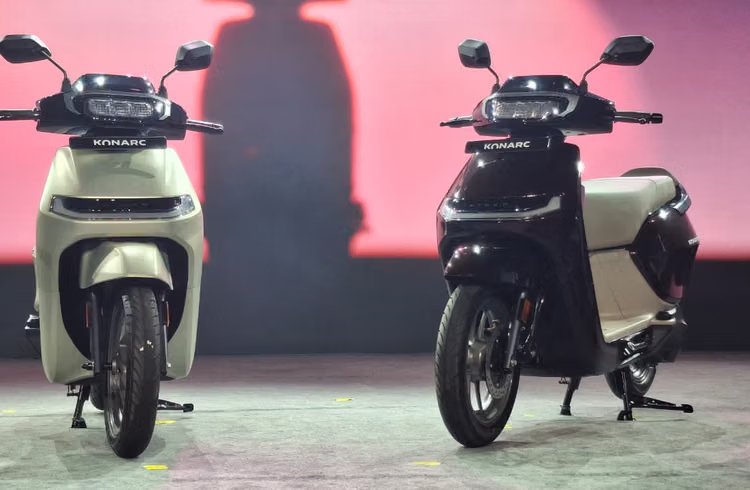
If you were waiting for the budget-friendly Konarc SR1 to hit the market this quarter, hold your horses. Ather Energy’s CEO Tarun Mehta confirmed on an analyst call that the entry-level variant is slipping to Q4 FY27. This wasn't a marketing ploy or a product rethink—it’s a brutal math problem. With current production lines maxed out, launching a lower-margin scooter would have cannibalized sales of the pricier SR2 and SR3 models, effectively shrinking the company’s profit margins. Mehta was blunt about it: selling the cheap model right now would be a "margin loss... which is not very healthy."
The context here is supply shock. Ather is currently leaving money on the table, unable to fulfill an estimated 18,000 to 20,000 units of monthly retail demand. Pre-orders have more than doubled year-on-year to roughly 1.80 lakh units in Q2 FY27, while monthly production hovers around 33,000 units. To bridge this gap, Ather is injecting an additional ₹122 crore to expand annual capacity by 2.25 lakh units across its Hosur and the upcoming AURIC facility in Chhatrapati Sambhajinagar. The priority is clear: fulfill existing high-margin orders before flooding the market with the entry-level model.
This bottleneck has rippled into the dealer network. Ather has paused the rollout of hundreds of new experience centers because it couldn’t guarantee inventory for new outlets. "We do not want dealers to sit on without inventory," Mehta explained. The company added fewer than 50 centers in the last two quarters and plans to restart aggressive expansion only toward the end of Q3 FY27. For buyers, this means the Konarc’s geographic availability will likely expand from its initial focus in UP and Rajasthan to southern markets only as production scales up.
On the pricing front, Ather is hitting a wall. Average ex-showroom prices have already jumped by about ₹14,000 between Q4 FY26 and Q2 FY27, moving from roughly ₹1.50 lakh to ₹1.64 lakh. Despite rising costs for aluminium, copper, and electronics, Mehta promised no further hikes in the December quarter. The company is betting on its new EL platform, which underpins the Konarc, to offer a cost advantage. Mehta noted that Konarc variants are already a few thousand rupees cheaper to build than the older Rizta, potentially delivering gross margins 6-7% higher once production stabilizes.
The timeline for relief is specific. Hosur’s capacity will bump up to 4.95 lakh units by December 2026. Meanwhile, the AURIC facility kicks off commercial production in phases starting December 2026 with an initial 5 lakh units, scaling to 6.5 lakh by Q2 FY28. That brings total installed capacity to roughly 11.4 lakh units annually. Until those lines are humming, the Konarc SR1 remains on the back burner, and buyers should expect continued scarcity on the mid-range models.